
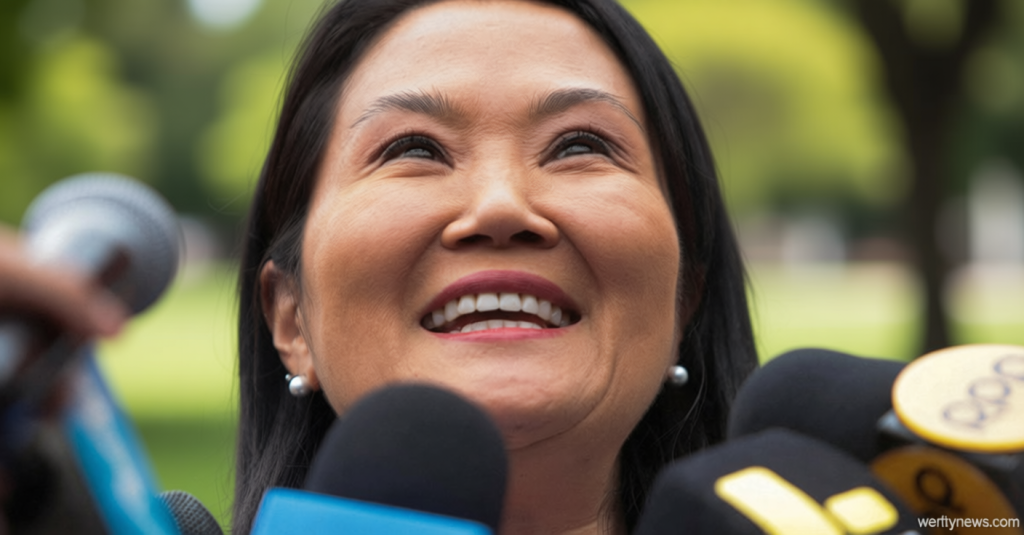
Keiko Fujimori’s Right-Wing Campaign Sees Strong Lead in Peru Runoff
Election Outlook and Current Standings
Wertynews.com – As the final stages of Peru’s presidential runoff election unfold, Keiko Fujimori, the right-wing presidential hopeful, has emerged as a clear frontrunner, according to the latest official tally data. With 99.86% of the ballots counted, Fujimori holds a commanding 50.12% of the vote, narrowly outpacing her leftist rival Roberto Sánchez by more than 43,000 votes. The National Office of Electoral Processes (ONPE) released these updated figures online, signaling a potential shift in the country’s political direction. Fujimori, the daughter of former president Alberto Fujimori, is positioned to secure a decisive victory, which could mark the end of a tumultuous era in Peruvian politics.
The race, held on June 7, pits Fujimori against Sánchez, the political heir of the late former president Pedro Castillo. With the outcome still pending, election officials have yet to confirm the winner, as a final 131 tally sheets—representing approximately 39,000 remaining votes—await processing. Sánchez, who has alleged procedural irregularities, warned that he would not accept a government led by Fujimori unless the electoral process is deemed fair. His concerns are amplified by the significant number of overseas votes, with around 300,000 ballots cast abroad, where Fujimori reportedly gained strong support from Peruvian diasporas in the United States and Japan.
“A serious violation of the electoral process,”
Sanchez claimed, emphasizing fears that the counting of overseas ballots might have been manipulated to favor Fujimori. His campaign has pointed to discrepancies in the handling of these votes, suggesting they could influence the final result. Meanwhile, Fujimori’s team remains optimistic, stating they will wait for the full count before declaring victory. The upcoming announcement of results, expected by mid-July, will determine whether the right-wing candidate will secure her place in the presidency for a five-year term.
Political Context and Voter Demographics
The runoff election comes amid a backdrop of political instability that has characterized Peru in recent years. The nation has experienced a series of leadership changes, including the imprisonment of former president Pedro Castillo and the removal of other leaders through impeachment. Fujimori’s campaign has positioned itself as a stabilizing force, appealing to voters in coastal urban centers who have traditionally favored pro-market policies and anti-corruption measures. However, the narrow margin of victory indicates that the country’s deep regional divides—particularly between the urban south and Indigenous communities in the north—continue to shape the political landscape.
Peru’s right wing presidential hopeful, Fujimori, has built her campaign around restoring economic confidence and cracking down on corruption, themes that resonate with many voters disillusioned by years of political turmoil. In contrast, Sánchez has framed his bid as a movement for social equity, targeting the working class and rural populations. Despite these differences, both candidates have struggled to bridge the gap between urban and rural voters, with Fujimori’s lead suggesting a stronger alignment with the coastal regions and business interests. This dynamic underscores the challenges of uniting a diverse electorate under a single political vision.
The election also reflects broader trends in Latin America, where right-wing leaders have gained traction in recent years. Fujimori’s potential victory could solidify this pattern, with analysts suggesting that her win might signal a shift toward conservative governance in the region. Her campaign has leveraged the legacy of her father, Alberto Fujimori, a former president known for his neoliberal reforms and authoritarian tendencies, to appeal to voters who prioritize economic stability over populist rhetoric. This strategy has proven effective in the current climate, where many citizens are eager for a return to predictable leadership.
Implications for Peruvian Politics
If Fujimori secures the presidency, it will mark a significant moment in Peruvian political history. As the daughter of a former leader who was ousted in a 2000 corruption scandal, she has positioned herself as both a continuation of the Fujimori era and a reformist candidate. Her victory could bring about a new era of economic policies focused on reducing inflation and attracting foreign investment, though critics warn of the risks of repeating past mistakes. The political opposition, which has been fragmented and ineffective in recent years, may face a major challenge in contesting her mandate, especially with the backing of a powerful media network and financial institutions.
The runoff has also highlighted the resilience of Fujimori’s political base. Despite the controversies surrounding her father’s presidency, she has managed to build a strong coalition of supporters, including former members of the Fujimori government and business leaders. This alliance has been crucial in her campaign, as it provides her with the resources and influence needed to navigate the complex electoral landscape. Meanwhile, Sánchez’s campaign, which has been marked by accusations of bias and procedural issues, has struggled to gain momentum, particularly in the absence of a unified opposition front.
Analysts suggest that Fujimori’s win would not only reshape the political direction of Peru but also have far-reaching implications for regional politics. As a key player in the right-wing movement across Latin America, her leadership could inspire similar candidates in neighboring countries. However, the outcome of this election may also deepen the divide between urban and rural voters, with Fujimori’s focus on economic reforms potentially alienating those who prioritize social programs. The final results, expected to be announced on July 28, will determine whether Peru is moving toward a new political consensus or further entrenching its right-wing dominance.