
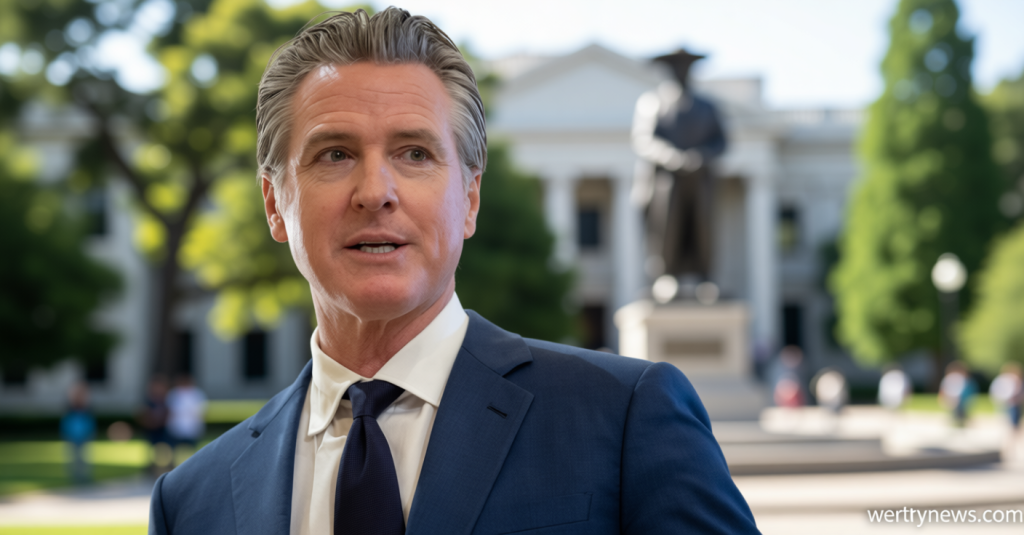
California Gov Gavin Newsom Proposes Billionaire Tax and AI Investment Fund
Wertynews.com – California Governor Gavin Newsom has unveiled a sweeping economic agenda that includes a federal billionaire tax and a public equity fund focused on artificial intelligence. In a recent essay, the governor outlined his vision to tackle wealth inequality and prepare the U.S. workforce for the transformative potential of AI technology. His proposals aim to reshape the tax system and channel resources into innovation, addressing gaps in current economic policies.
Federal Billionaire Tax Plan
Newsom’s federal billionaire tax proposal targets the tax advantages enjoyed by the ultra-wealthy, particularly those who utilize “tax-free lifestyle loans” to shield income from taxation. These loans allow individuals to borrow against their stock holdings, report minimal earnings, and pass assets to heirs without immediate tax consequences. The governor argues that such practices perpetuate economic disparities, with the top 1% of earners capturing the lion’s share of wealth growth over the past decade. By introducing a minimum federal tax on high-net-worth individuals, Newsom hopes to ensure that the wealthiest contribute their fair share to public coffers.
Newsom also calls for reinstating corporate tax rates to pre-2017 levels, a move he believes would curb profit-shifting strategies and boost wages for workers. He critiques the current system, which he claims has favored executive compensation and stock buybacks over equitable income distribution. “Trickle-down economics has been a 50-year experiment that hasn’t worked for the average worker,” he stated, emphasizing the need for a more balanced approach to economic policy.
AI Public Equity Fund Initiative
A central component of Newsom’s plan is the creation of a national AI public equity fund, designed to invest in emerging technologies and support displaced workers. This initiative would involve acquiring stakes in AI-driven industries, generating revenue to fund programs like portable benefits, expanded unemployment insurance, and retraining opportunities. The governor envisions a broader strategy to transition the workforce into the “AI century,” ensuring that the benefits of technological advancement are shared more widely across society.
Newsom highlights that the state’s proposed billionaire tax would primarily benefit Medicaid, but he argues it overlooks other critical areas like public education and childcare. He believes a federal framework would address these systemic issues more effectively, as it would prevent wealthy individuals from avoiding taxes by relocating to states with lower rates. The public equity fund, he suggests, could serve as a model for how the federal government might strategically invest in the future of work.
Newsom’s proposals reflect a growing bipartisan concern over the pace of AI development and its economic implications. A recent YouGov/Economist survey found that 71% of Americans, including 77% of Democrats and 68% of Republicans, believe AI is advancing too quickly. Newsom’s plan seeks to align federal policy with this sentiment, ensuring that technological progress is accompanied by safeguards for workers and equitable wealth distribution.
The governor’s push for these measures comes as he prepares for the 2028 Democratic presidential race. By advocating for a federal billionaire tax and an AI investment fund, Newsom positions himself as a forward-thinking leader in the national conversation about economic reform. His ideas could influence future policy debates, particularly as AI continues to reshape industries and employment patterns across the country.