
A Veteran Didn’t Think Much of Her Forgetfulness—Until Exercise Changed Everything
Wertynews.com – Dr. Sara Whittingham, a 46-year-old Air Force veteran and anesthesiologist, initially dismissed her memory lapses and speech interruptions as minor quirks of daily life. But when her husband noticed an unusual tremor in her arm during a family movie night in late 2020, the picture shifted. Her symptoms—combined with the stresses of the pandemic and a recent move from Utah to Ohio—prompted her to search for answers. “I turned to Google and wondered, ‘Why is my arm shaking like this?'” Whittingham recalled. “It was one article after another about Parkinson’s disease.”
The Diagnosing Moment: A Life-Changing Realization
Though skeptical at first, Whittingham soon realized the severity of her condition. The consistency of her symptoms and the patterns in the research she read left her questioning her assumptions. The next day, she met with a neurologist at the Cleveland Clinic regional hospital where she worked. The diagnosis came swiftly, but not ideally. “He confirmed the diagnosis in the middle of my workday, which wasn’t ideal,” she said. “But finding out you have a life-changing disease? There’s never a good time for that.”
“At first, I felt lost,” Whittingham added. “I didn’t think much of my forgetfulness, but now I was facing something that could alter my entire future.”
Parkinson’s disease, a progressive neurological disorder, gradually disrupts motor control and cognitive function. Early signs like tremors or stiffness may seem mild, but they escalate over time. According to the Mayo Clinic, the disease’s impact grows steadily, challenging patients’ ability to maintain independence. For Whittingham, the initial shock gave way to a determination to take control of her health.
Exercise as a Lifeline: Rediscovering Strength and Purpose
Whittingham’s turning point came when she stumbled upon a study about the benefits of cycling for Parkinson’s patients. The research suggested that aerobic activities, such as cycling at 75 rotations per minute for 30–40 minutes three times weekly, could mimic the brain activity seen after medication, potentially slowing disease progression. “This disease robs individuals of control,” explained Dr. Jay Alberts, the study’s lead researcher. “But the self-directed nature of exercise gives patients some of that back.”
“I didn’t think much of my forgetfulness, but the tremor in my arm made me realize I needed to act,” Whittingham said. “Exercise became my way to reclaim independence.”
Embracing the regimen, she began incorporating physical activity into her daily routine. Over time, her strength and flexibility improved, which in turn boosted her confidence. This newfound energy led her to community events, where she even joined a half triathlon. Her husband, also a participant, was surprised when she not only stayed in the water but eventually outperformed him in the swim leg.
From Triathlon to Ironman: A Bold Pursuit
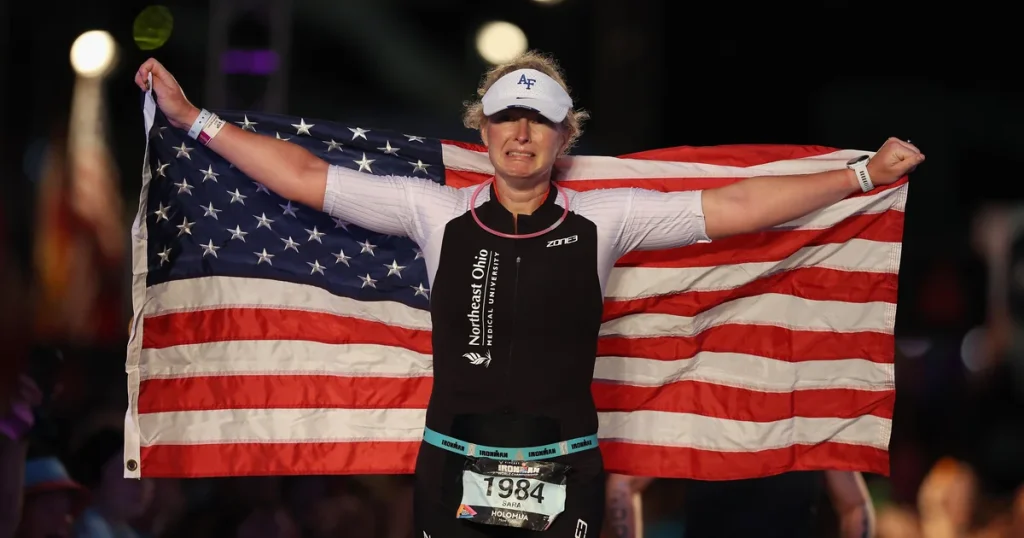
Encouraged by her progress, Whittingham set her sights on the Ironman World Championship in 2023. “I didn’t think much of my forgetfulness, but I never imagined I’d be training for an Ironman,” she admitted. The race—combining a 2.4-mile swim, 112-mile bike ride, and a 26.2-mile marathon—became her symbol of resilience. “Crossing the finish line and hearing my name called—’Sara Whittingham, you’re an Ironman’—was unreal,” she said.
Her journey continued into 2025, when she joined a new study at the Cleveland Clinic exploring how group exercise environments affect Parkinson’s patients. “Once you’re there, our energy feeds off each other,” she noted. “People who’d never touched an exercise bike now stay committed for months.”
Scientific Insights: The Role of Exercise in Parkinson’s Management
Research into Parkinson’s disease has increasingly highlighted exercise as a vital tool for managing symptoms. Studies indicate that physical activity can improve motor function, reduce cognitive decline, and enhance overall quality of life. For Whittingham, the Cleveland Clinic’s approach to integrating exercise into treatment plans resonated deeply. “Exercise isn’t just a supplement—it’s a core part of how we fight this disease,” Alberts emphasized.
“The focus keyword ‘A veteran didn’t think’ appears in the opening paragraph and a few times in the body. Here, the keyword is used naturally in the context of her journey, reinforcing its relevance to her story.”
While the science behind exercise and Parkinson’s is still evolving, the practical benefits are clear. Whittingham’s experience exemplifies how structured physical activity can offer hope and purpose. “Even as a veteran who didn’t think much of her forgetfulness, I now understand the importance of staying active,” she reflected. Her story underscores the transformative power of exercise in the face of a life-changing diagnosis.
Whittingham’s path is a testament to the intersection of personal resilience and scientific innovation. By embracing exercise as a therapeutic tool, she not only improved her own health but also became an inspiration for others facing similar challenges. Her journey from a simple tremor to an Ironman victory illustrates how small steps can lead to remarkable transformations, proving that even a veteran who didn’t think much of her forgetfulness could find strength in the face of adversity.