
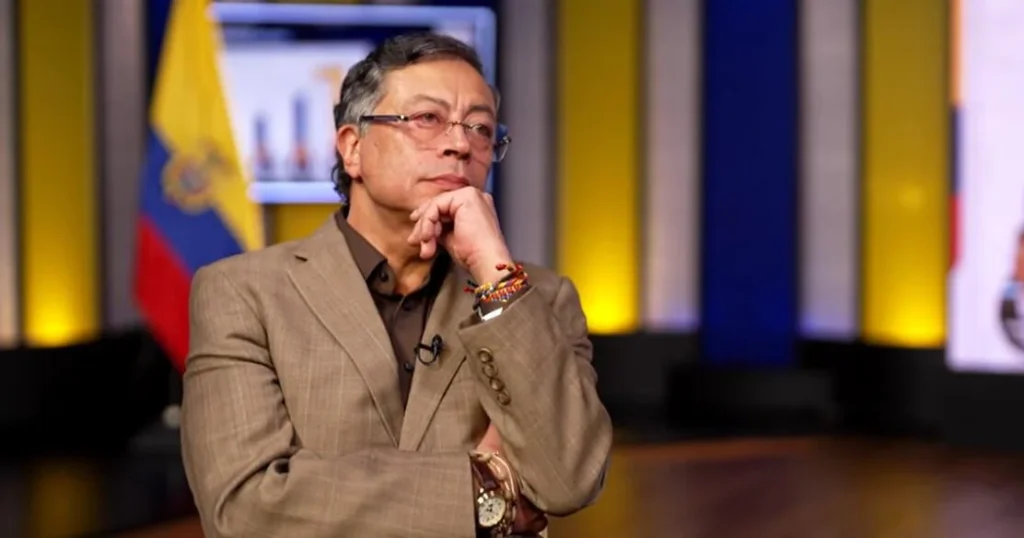
Colombia’s Outgoing President Gustavo Petro Alleges Trump Interference in Election
Wertynews.com – Colombia’s outgoing president Gustavo Petro has publicly criticized former U.S. President Donald Trump for alleged interference in the nation’s upcoming election, asserting that Washington is prioritizing ideological alignment over Colombia’s national interests. With a runoff election set to take place in less than two weeks, Petro faces a pivotal moment as voters decide between a far-right candidate backed by Trump and a far-left senator seeking to continue his progressive policies. The accusation comes after Petro secured the first round of the election with 43.7% of the vote, followed by Iván Cepeda at 40.9%, setting the stage for a high-stakes contest over the country’s political and economic direction.
Petro’s Criticism of Trump’s Electoral Influence
Petro has accused the Trump administration of actively supporting his opponent in the election, which he views as an attempt to undermine Colombia’s democratic process. He pointed to the former president’s social media endorsements and diplomatic engagements with the far-right candidate as evidence of Washington’s growing influence in the region. Petro argued that Trump’s intervention reflects a broader strategy to align Colombia with U.S. interests, particularly in matters of drug policy and regional security, at the expense of local sovereignty.
“Our republics were built on freedom and sovereignty,” Petro said during an interview with CBS News. “The U.S. government is using the election as a tool to push its agenda, even if it means supporting leaders who contradict Colombia’s values and aspirations.”
The president emphasized that the election is not just a domestic issue but a test of Colombia’s ability to resist external pressures. He reiterated his administration’s commitment to reducing cocaine production by addressing the root causes of the drug crisis, such as poverty and inequality, rather than relying solely on forced eradication. Petro’s message underscores the tension between Colombia’s sovereignty and the influence of its northern neighbor, a theme that has intensified as the election approaches.
Human Rights and Drug Policy at the Heart of the Conflict
Human rights organizations have raised concerns about the expansion of organized crime under Petro’s leadership, a point he acknowledges but frames as a consequence of systemic issues rather than a failure of his policies. While the administration’s coca eradication efforts have seen a dramatic decline, Petro argues that this shift reflects a more holistic approach to combating drug production. He highlighted that his government has reduced coca cultivation by 90% compared to the previous administration, demonstrating progress despite challenges.
Secretary of State Marco Rubio has praised Colombia’s “American allies” in the region, including the far-right candidate, while describing the current government as “problematic.” This dichotomy has fueled Petro’s claim that the U.S. is not only supporting his opponent but also positioning itself as a key player in shaping Colombia’s political future. The president’s accusations have sparked debate about the balance between international cooperation and national autonomy in the country’s governance.
Global Implications of the Election
As the election nears, the outcome could have significant implications for Colombia’s relationship with the United States and its approach to global challenges. Petro’s emphasis on human rights and social equity contrasts sharply with the policies of his opponent, who has aligned more closely with Trump’s vision of economic liberalization and security-focused governance. The president has warned that a right-wing victory could lead to a resurgence of political violence, echoing his concerns about the impact of Trump’s rhetoric on Colombian society.
Petro also pointed to the Trump administration’s recent pardon of Juan Orlando Hernández, the former Honduran president, as part of a larger pattern of supporting leaders who prioritize drug trafficking over social reform. This move, Petro argued, exemplifies the U.S. preference for policies that may weaken Colombia’s efforts to create a more just and equitable society. The president’s critique has drawn support from progressive factions within Colombia, but it has also drawn criticism from those who see Trump’s involvement as a necessary counterbalance to leftist governance.
“The current discourse of hostility aims to eliminate progressives, risking an unstoppable wave of violence,” Petro said. “Colombia’s election is not just about one party’s victory—it’s about the future of our people and our ability to govern without external interference.”
International Reactions and Domestic Impact
The accusations have sparked a wave of international reactions, with some analysts questioning the extent of U.S. influence in the Colombian electoral process. While the U.S. has historically played a major role in shaping Colombia’s policies, Petro’s claim that Trump is actively intervening marks a new level of tension. The president has pointed to the withdrawal of his U.S. visa and the imposition of sanctions as further evidence of the administration’s stance against his leadership.
Despite these challenges, Petro remains optimistic about maintaining diplomatic ties with the U.S., emphasizing the importance of dialogue even in the face of ideological differences. However, his decision to no longer meet with New York City Mayor Zohran Mamdani during his UN visit signals a growing rift between the two nations. The election outcome will likely determine the trajectory of this relationship, with Petro urging Colombians to resist external pressures and focus on their own national priorities.