
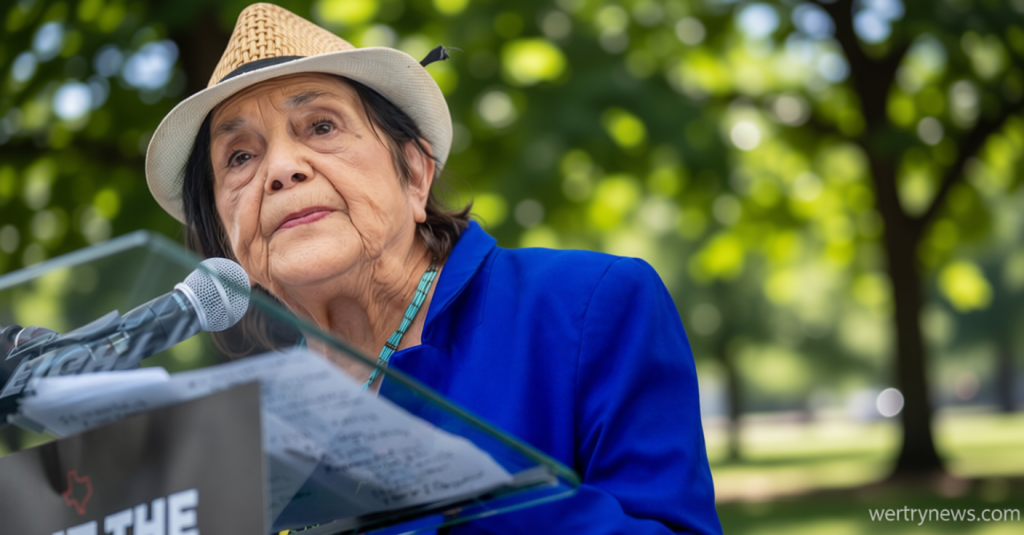
Dolores Huerta: Trump Lacks Historical Understanding of Mexican People
Wertynews.com – Labor activist Dolores Huerta says President Donald Trump’s recent remarks about Mexican immigrants have sparked criticism, with Huerta emphasizing that Trump “does not know history.” During a recent CBS News interview, the 96-year-old advocate, known for her decades-long fight for workers’ rights, called out Trump’s portrayal of Mexican people as a reflection of his limited grasp of the country’s past. Huerta argued that these statements ignore the deep historical connections between Texas and Mexico, and fail to acknowledge the contributions of Mexican Americans to the nation’s development. Her critique underscores the importance of accurate historical context in shaping public perception of immigrant communities.
Trump’s Rhetoric and the Mexican-American Legacy
Huerta pointed to Trump’s 2015 campaign speech, in which he claimed Mexico “was not sending their best” and accused the country of sending “drugs, crime, and rapists.” She highlighted how this rhetoric overlooks the shared history between the United States and Mexico, particularly in Texas, which was a Mexican territory before becoming a U.S. state in 1845. “He does not know history,” labor activist Dolores Huerta says, stressing that Trump’s comments ignore the region’s colonial roots and the cultural richness of Mexican heritage. This disconnect, Huerta believes, is part of a broader strategy to divide Latino communities and undermine their political influence.
“This is our moment,” Huerta remarked, urging Latino voters to recognize their power in shaping the nation’s future.
Advocacy Roots and the Power of Language
As a co-founder of the United Farm Workers (UFW) in the 1960s, Huerta played a pivotal role in advocating for agricultural laborers, many of whom were Mexican-American. Her popularization of the phrase “si, se puede” – translated to “Yes, we can” in English – became a powerful symbol of grassroots activism. However, her focus on historical accuracy has also led to scrutiny, particularly regarding her criticisms of Cesar Chavez. Despite this, Huerta’s emphasis on the importance of understanding history remains central to her work. “History is not just about facts; it’s about who gets to tell it,” labor activist Dolores Huerta says, reinforcing the idea that narratives shape public opinion and policy.
Latinx Voter Mobilization and Electoral Impact
At the Texas Democratic Convention, Huerta reiterated her belief that the Latino vote is a decisive factor in statewide elections. She noted that in 2018, Democratic Senate candidate Beto O’Rourke received 64% of the Latino vote, a significant achievement that narrowed the gap against Republican Ted Cruz. Labor activist Dolores Huerta says the 2026 elections will be a critical test of whether the Democratic Party can capitalize on this momentum. “If it can happen in California, it can happen in Texas,” she remarked, drawing parallels between the states’ evolving political landscapes and the potential for Latino voter power to reshape the nation’s direction.
“Trump’s ignorance of history is not just a mistake; it’s a deliberate effort to mislead,” Huerta explained, stressing the need for informed leadership.
Historical Inaccuracies and Political Consequences
Huerta’s critique of Trump’s historical misstatements extends beyond isolated remarks. She has long argued that the president’s rhetoric perpetuates stereotypes that marginalize Mexican Americans and undermine their contributions to U.S. society. For instance, Trump’s claim that Mexico “was sending its best” ignores the fact that Mexican immigrants have historically been instrumental in the labor and civil rights movements. By dismissing this history, Huerta contends, Trump weakens the foundation for inclusive policies and fuels division among communities. “He does not know history,” labor activist Dolores Huerta says, “so he cannot understand the importance of solidarity.”
Expanding the Fight for Historical Truth
While focusing on Trump’s mischaracterizations, Huerta has also highlighted the broader implications of historical neglect. She stressed that the UFW’s success in the 1960s was built on a deep understanding of the struggles faced by Mexican laborers, both in the U.S. and in Mexico. “We must teach history accurately,” she urged, calling for educational initiatives that center the voices of marginalized communities. Huerta’s message aligns with a growing movement among historians and activists to correct the narratives that have been used to justify discrimination. “History is a tool,” labor activist Dolores Huerta says, “and it’s time we use it to build a more just future.”
“The power of history is in its ability to unite people and challenge injustice,” Huerta concluded, reinforcing her lifelong commitment to advocacy.