
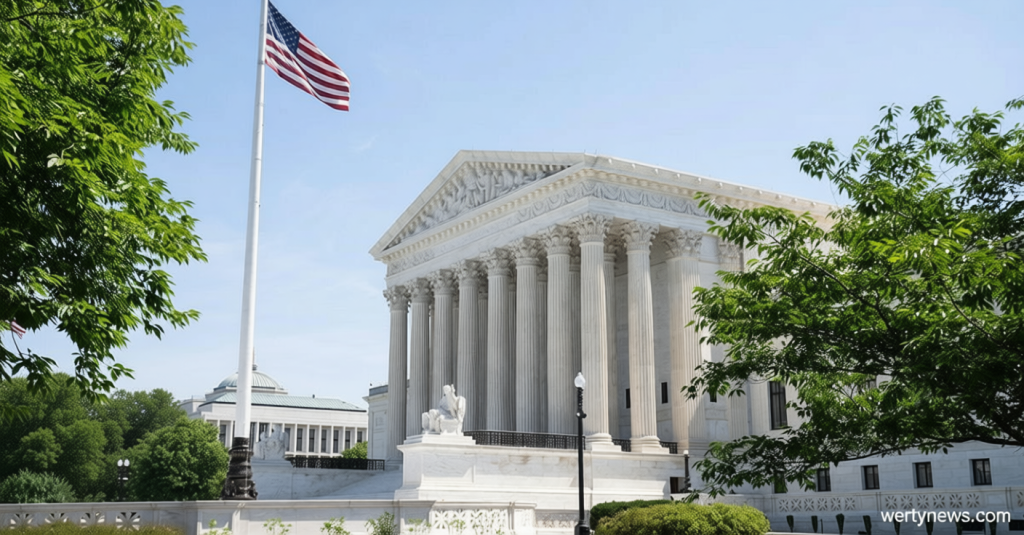
Supreme Court says nation’s top copyright official can keep job for now
Wertynews.com – In a landmark ruling, the Supreme Court has temporarily halted President Donald Trump’s effort to remove the nation’s chief copyright officer, Shira Perlmutter. The decision preserves an earlier order from the U.S. Court of Appeals for the District of Columbia Circuit, which had reinstated her position. This move underscores a critical moment in the ongoing legal battle over executive power and its impact on the legislative branch’s authority.
Perlmutter’s case has become a focal point in the broader debate about the limits of presidential control over federal agencies. Her position as Register of Copyrights, under the Library of Congress, was terminated shortly after she delivered a pivotal report on artificial intelligence’s influence on copyright law. The Trump administration had previously removed Carla Hayden, the librarian of Congress, and then instructed her replacement to oust Perlmutter. However, the Supreme Court’s intervention has cast doubt on the administration’s claim that such officials are entirely within the executive branch.
Separation of Powers at the Center of the Dispute
The legal conflict hinges on the interpretation of the U.S. Constitution’s separation of powers principle. Perlmutter’s attorneys argued that her removal was unconstitutional, asserting that the president lacked authority to appoint an acting librarian of Congress without Senate confirmation. They framed the action as a direct challenge to the legislative branch’s autonomy, with Judge Florence Pan of the D.C. Circuit Court of Appeals emphasizing that her role is uniquely tied to advising Congress on copyright matters.
While the Supreme Court’s decision does not resolve the core legal questions, it signals a cautious approach to the Trump administration’s attempts to consolidate power. The ruling allows Perlmutter to remain in her position temporarily, pending further legal proceedings. This outcome contrasts with previous cases where the court had supported the administration’s actions, such as the dismissal of the Federal Trade Commission’s chair.
“The executive’s alleged blatant interference with the work of a Legislative Branch official, as she performs statutorily authorized duties to advise Congress, strikes us as a violation of the separation of powers,” wrote Judge Florence Pan in a concurring opinion. “This is a unique position within the legislative branch,” she added, highlighting that Perlmutter’s role was not merely administrative but deeply rooted in legislative function.
Broader Implications for Executive Authority
The case has sparked discussions about the potential expansion of presidential power over independent agencies. Legal experts note that the Trump administration’s strategy to remove key officials has aimed to reshape policy directions aligned with their priorities. Perlmutter’s dismissal, which followed her AI report, was seen as an effort to influence copyright law in favor of corporate interests, raising concerns about the balance of power between branches of government.
Despite the temporary victory for Perlmutter, the Supreme Court’s decision leaves room for further debate. The ruling does not fully address whether the president’s authority to remove the librarian of Congress and register of copyrights is valid. This ambiguity could lead to prolonged legal battles, with implications for how future administrations manage such roles. The case also serves as a test for the constitutionality of executive overreach in an era of divided government.
As the legal process continues, the outcome will likely shape how Congress and the executive branch interact on issues of regulatory oversight. Perlmutter’s position, which has been central to the debate, highlights the importance of statutory duties in maintaining checks and balances. The Supreme Court’s decision to block her removal temporarily may be a strategic move to allow more time for the administration to present its case, or it could signal a broader trend of judicial restraint in such matters.
With the nation’s top copyright official now poised to stay in her post, the case remains a symbol of the ongoing tensions between executive power and legislative independence. The Supreme Court’s ruling, while not definitive, has provided a critical reprieve for Perlmutter and reinforced the idea that certain roles within the legislative branch warrant constitutional protection. This development may influence future policy decisions and set a precedent for how similar disputes are handled in the years to come.