
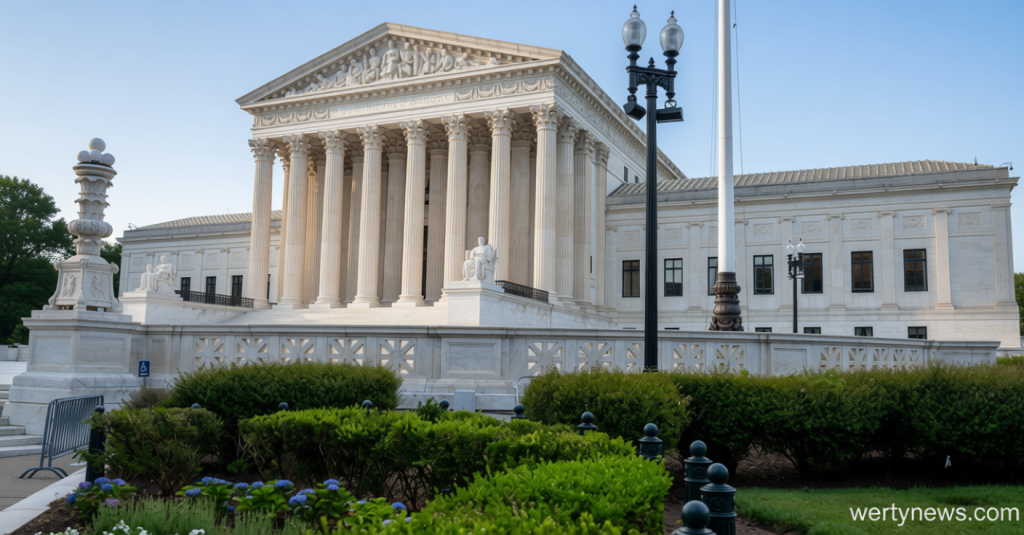
Supreme Court Strikes Down Hawaii Gun Law Restricting Private Property Carry
Wertynews.com – The Supreme Court has ruled in favor of gun rights by striking down Hawaii’s law that restricted individuals with concealed-carry permits from carrying firearms onto private property open to the public. This landmark decision, announced on Thursday, marks a significant shift in the interpretation of the Second Amendment, affirming that the right to bear arms extends beyond one’s home to public spaces accessible to others. The 6-3 ruling in Wolford v. Lopez has sparked debate over the balance between individual freedoms and property rights, with proponents praising the court’s stance and critics calling it a move toward broader gun access.
Legal Framework and Majority Argument
The court’s decision was grounded in its 2022 framework, which requires gun restrictions to align with historical traditions of firearm regulation. Justice Samuel Alito, leading the majority, argued that Hawaii’s law was an overreach, stating it “hobbles what the Second Amendment protects: the right of Americans to carry arms for self-defense as they go about their daily lives.” The majority emphasized that the “spirit of Aloha” cited by Hawaii could not override the constitutional right to bear arms. This reasoning echoes previous rulings that have expanded gun rights in various contexts, such as public parks and transportation hubs.
“The Second Amendment has the same meaning in all parts of the United States. It cannot give way to ‘the spirit of Aloha’ in Hawaii.” — Justice Samuel Alito
Hawaii’s law, known as the “vampire rule,” imposed a unique restriction by requiring permit holders to obtain permission before carrying guns on property accessible to the public. The Supreme Court’s ruling effectively nullifies this requirement, allowing gun owners to carry firearms on such premises without prior consent. The decision also underscores the court’s commitment to applying the Second Amendment uniformly, regardless of state-specific traditions or cultural arguments.
Impact on Gun Ownership and Legal Precedents
This ruling not only affects Hawaii but also sets a precedent that could influence similar laws in other states. While Hawaii is among five states with restrictions on private property carry, the decision may encourage challenges to laws in New York, California, and Maryland, which have previously faced judicial scrutiny. In the remaining 45 states, licensed handgun owners typically enjoy broad rights to carry firearms on publicly accessible private property. The new ruling reinforces that principle, expanding the scope of the Second Amendment’s protections.
Legal experts argue that the decision reflects a growing trend in the Supreme Court to prioritize individual rights over state regulations. The 2022 framework, which the court applied here, has already been used to uphold and invalidate various gun laws, demonstrating its adaptability. For Hawaii, this means that permit holders can now carry firearms on property open to the public without needing permission, aligning the state’s practices with federal interpretations of the Second Amendment.
The case originated in 2023 when three Maui County residents and the Hawaii Firearms Coalition challenged the law, asserting it violated constitutional protections. A federal district court initially ruled in their favor, but the 9th Circuit Appeals Court reversed that decision, upholding Hawaii’s rule. The Supreme Court’s reversal highlights the ongoing tension between state authority and federal constitutional standards, particularly in matters of gun rights.
Dissenting Perspectives and State Variations
Justice Ketanji Brown Jackson, in her dissent, emphasized the importance of property rights, noting that the Constitution does not guarantee unrestricted access to private property. She criticized the majority for using the 2022 framework to justify a broader interpretation of the Second Amendment, arguing it undermines legislative authority. Justice Elena Kagan joined the dissent, drawing parallels to historical laws that limited firearm carrying on private land without owner consent.
The ruling has implications for states with similar restrictions. While Hawaii’s law was struck down, other states have maintained their own rules, often citing public safety concerns. The Supreme Court’s decision may now prompt a reevaluation of those laws, especially as the court continues to refine its approach to gun rights. This case also reinforces the idea that the Second Amendment’s protections are not confined to the home, extending to public spaces where individuals exercise their rights.
The Supreme Court’s decision in Wolford v. Lopez represents a pivotal moment in the ongoing discourse about gun regulations. By striking down Hawaii’s law, the court has taken a clear stance that the Second Amendment applies consistently across the nation, even in states with unique cultural or historical justifications. This ruling not only impacts Hawaii but also signals a potential trend in how the Supreme Court interprets and enforces gun rights in the future.