
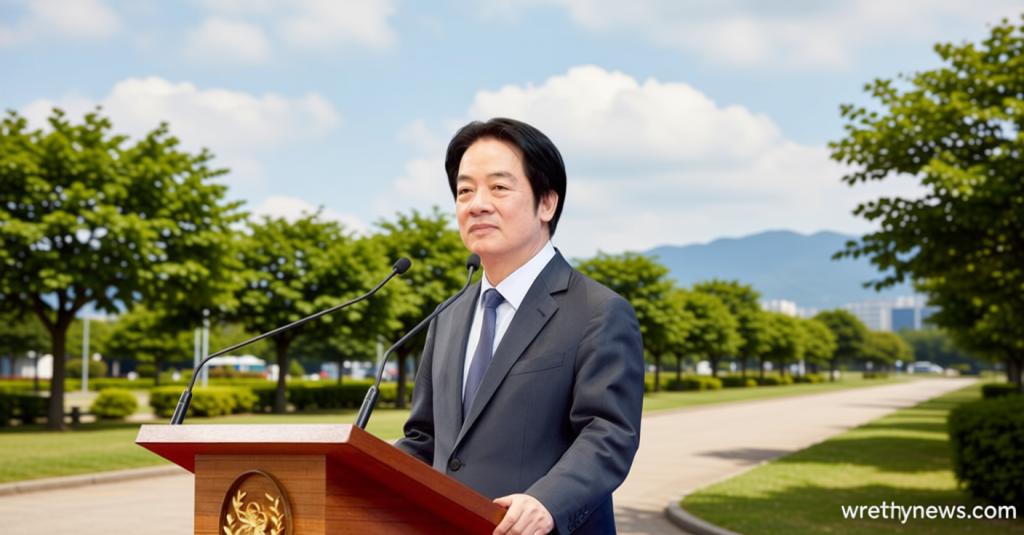
Trump Call with Taiwanese President on Hold
Wertynews.com – President Donald Trump’s anticipated conversation with Taiwan’s leader, President Lai Ching-te, has been delayed as part of broader diplomatic considerations tied to the upcoming visit of Chinese President Xi Jinping to the United States. Multiple sources close to the discussions informed CBS News that the U.S. administration is no longer planning to hold the call prior to Xi’s potential trip this fall. This shift comes amid heightened tensions over Taiwan’s status and its implications for U.S.-China relations.
Xi’s Warning During Trump’s China Visit
During Trump’s recent trip to Beijing, Chinese President Xi Jinping emphasized the importance of handling Taiwan with care, warning that the island could escalate into a “very dangerous situation” if the U.S. were to pursue an arms sale without diplomatic coordination. The warning was delivered in the context of their discussions, which focused on several key issues, including the potential military action against Taiwan. The White House confirmed that the two leaders exchanged detailed views on the matter, though the specifics of their conversation remain classified.
Despite Xi’s caution, Trump had previously signaled an interest in engaging directly with Lai Ching-te. In mid-May, the president made headlines by stating his intention to speak with the Taiwanese leader before finalizing a new package of defensive weapons. “I’ll speak to him,” he remarked during a press briefing, underscoring his commitment to understanding Taiwan’s perspective. “I have to speak to the person who is currently leading Taiwan,” he reiterated weeks later on Air Force One, highlighting the strategic value of direct communication.
Historical Context and Diplomatic Constraints
Since 1979, no U.S. president has held a formal conversation with a leader from Taiwan due to the One-China Policy. This principle, established through the Taiwan Relations Act, maintains diplomatic ties with China while allowing the U.S. to support Taiwan’s self-defense. However, Trump’s potential call with Lai Ching-te would mark a departure from this long-standing tradition, as it could signal a more assertive stance toward Taiwan’s autonomy.
Trump’s remarks in May sparked debate about the U.S. commitment to its allies in the region. While he acknowledged the importance of engaging with Taiwan’s leadership, his administration has yet to confirm a timeline for the call. The White House has cited the president’s comments as a reference, but no official statement has been released to clarify the situation. Meanwhile, Taiwan’s de facto embassy in the U.S., the Taipei Economic and Cultural Representative Office (TECRO), expressed continued hope for a dialogue, stating that it remains “waiting to hear from the U.S.” about the potential exchange.
The Arms Sale and Strategic Considerations
The delay in Trump’s call with Lai Ching-te is linked to the administration’s ongoing deliberations over a $14 billion arms sale to Taiwan. This package, which is currently under review, follows a previous $11 billion sale announced in December of the previous year. The State Department has not yet approved the new deal, leaving it pending Secretary of State Marco Rubio’s signature. The arms sale has become a focal point in the U.S. strategy to balance its relationship with China while strengthening its ties with Taiwan.
Acting Navy Secretary Hung Cao recently informed Congress that the sale had been temporarily paused to ensure the U.S. military had adequate supplies for operations in Iran. However, a source familiar with the negotiations later clarified that the delay was not connected to Iran and that the decision on the arms package would be made “soon.” This uncertainty reflects the complex interplay between military strategy and diplomatic relations in the region.
Under the Reagan-era Six Assurances agreement, the U.S. pledged not to cut off arms sales to Taiwan and to consult with Beijing on such matters. Trump’s comments during his return from China suggest that this commitment may be tested. “So, what am I going to do? Say ‘I don’t want to talk to you about it, because I have an agreement that was signed in 1982?’ No. We discussed arms sales,” he told reporters, indicating that the administration is weighing its options carefully.
Chinese officials have also weighed in on the matter. Following Trump’s mention of the potential call, a spokesperson for the Chinese Foreign Ministry reiterated Beijing’s opposition to “official exchanges between the U.S. and China’s Taiwan region.” They emphasized that the U.S. arms sales to Taiwan are “consistent, clear, and rock-firm,” aligning with their broader goal of maintaining influence over the island. This stance underscores the risk of military force in the region, as the Chinese Communist Party has long pledged to “reunify” Taiwan with the mainland.
Reaffirming Policy and Future Prospects
Taiwan and the United States continue to sustain open channels of communication, with the U.S. government reaffirming its support for the “status quo” and the stability of the Taiwan Strait. The TECRO highlighted this in a statement to CBS News, asserting that the U.S. policy on Taiwan remains unchanged. This includes the provision of defensive weapons and the maintenance of diplomatic relations, even as tensions with China intensify.
While the call with Lai Ching-te has been postponed, the administration is still considering other diplomatic avenues. A White House official confirmed that the president’s team has not ruled out direct engagement, though no specific plans have been announced. Trump’s invitation to Xi Jinping for a visit on September 24 was also highlighted, though the Chinese leader has yet to confirm attendance. The timing of this visit could further shape the U.S. approach to Taiwan and its implications for regional stability.
Qiu Wenxing, deputy chief of mission at the Chinese Embassy in Washington, D.C., addressed the potential for a state visit, stating that while Xi Jinping has agreed to come to the U.S. in the fall, “the date has to be determined.” He added that “favorable conditions have to be created prior to such an important state visit,” suggesting that the administration may adjust its approach based on diplomatic developments. This statement reinforces the idea that the U.S. and China are engaged in a delicate balancing act, with Taiwan serving as a critical point of contention.
Despite the delay in the call, Trump’s administration has shown a willingness to keep options open. Two sources close to the discussions noted that the president frequently favors flexibility in international relations, particularly when it comes to issues involving Taiwan. This approach has raised questions about the extent of U.S. support for the island, as well as its potential impact on the broader China-U.S. relationship. The outcome of these deliberations could set the stage for significant shifts in the region’s geopolitical landscape.