
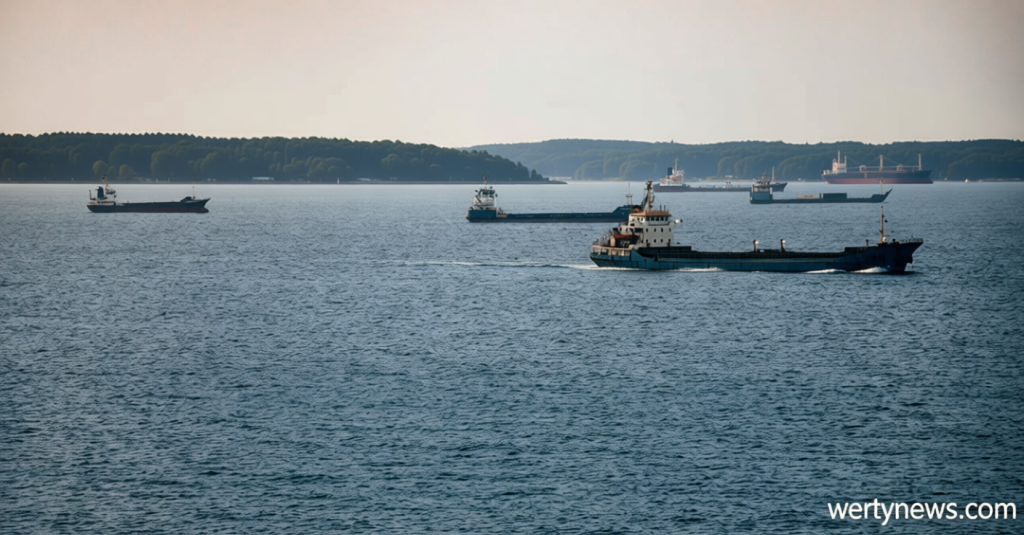
U.S. Targets Iranian Facilities in Response to Drone Strike on Cargo Ship, Testing Ceasefire Agreement
Wertynews.com – Following an Iranian drone attack on a commercial vessel in the Strait of Hormuz, the U.S. military conducted strikes on Iranian positions, signaling the first direct retaliation since the two nations extended a fragile ceasefire last week. According to a statement by U.S. Central Command, the actions focused on missile and drone storage sites, as well as radar installations, aiming to counter Iran’s “dangerous behavior.” The operation, carried out by land-based aircraft, concluded after hitting four designated targets.
A U.S. official confirmed to CBS News that the strikes occurred along the Strait of Hormuz and on Iran’s Qeshm Island. The official noted that six aircraft participated in the mission, which was completed without further escalation. The attack on the cargo ship, which damaged its bridge but caused no casualties or environmental harm, took place off Oman’s coast, as reported by the U.K. Maritime Trade Operations Centre.
“The unwarranted aggression against commercial shipping by Iranian forces clearly violated the ceasefire,” said CENTCOM.
Iran’s Drone Attack and U.S. Retaliation
The incident came just a day after Iran’s Islamic Revolutionary Guard Corps targeted a Singapore-flagged cargo ship. President Trump labeled the strike a “foolish violation” of the U.S.-Iran ceasefire, which was extended for 60 days via a memorandum of understanding. When asked about potential consequences, he replied: “You’ll find out.”
Meanwhile, the Iranian government emphasized that any passage through routes outside its designated framework would lack guaranteed safety and insurance coverage. This statement was issued by the Persian Gulf Strait Authority, highlighting ongoing tensions over maritime control.
Impact on Ceasefire and Regional Trade
The renewed U.S. strikes could hinder efforts to reopen the Strait of Hormuz, which had been blocked by Iran for months. The United Nations’ International Maritime Organization temporarily paused an evacuation plan for ships stranded in the Persian Gulf after the attack, citing that the vessel was not under its evacuation protocol.
The U.S.-Iran agreement stipulates that Iran must ensure unimpeded passage through the strait for 60 days. Shortly after the deal was signed, shipping activity increased, and oil prices dropped to levels last seen before the war. However, disputes over routing persist: the U.S. prefers a southern route near Oman, while Iran insists on a northern passage closer to its shores. Iran has also not ruled out imposing tolls on commercial vessels after the 60-day period.
Future Negotiations and Ceasefire Challenges
With negotiations on Iran’s nuclear program set to continue for the next two months, the effectiveness of the U.S. response remains uncertain. The initial ceasefire, established in early April, was tested by mutual strikes but avoided a full resumption of large-scale bombing campaigns. Vice President JD Vance, leading U.S. talks with Iran, reiterated the commitment to the agreement: “Iran signed a ceasefire. We have honored it. If they have disagreements about how the [memorandum] is being applied, they can pick up the phone. But violence will be met with violence.”