
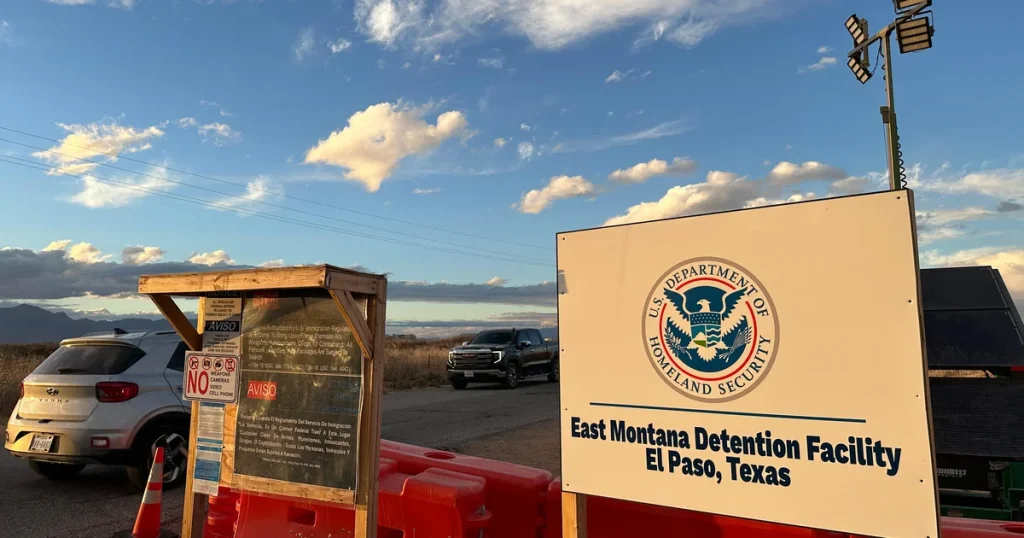
GAO Report Highlights Major Deficiencies in Fort Bliss ICE Detention Facility
Wertynews.com – A federal oversight agency has identified significant shortcomings in the operation of the Immigration and Customs Enforcement (ICE) facility located within Fort Bliss, Texas. The report, released by the Government Accountability Office (GAO), reveals that the Trump administration’s approach to housing immigrant detainees at the site led to financial waste, unsanitary living conditions, and insufficient tuberculosis prevention measures. Additionally, an incident involving a lost firearm further underscores the facility’s operational challenges.
The facility, named Camp East Montana, was operational from August 2025 to March 2026, during which time it faced multiple serious incidents. Two deaths were investigated by the GAO, including a case of asphyxiation in January that was later classified as a homicide by an autopsy. This death is now under criminal scrutiny. Another detainee died by suicide in January after being left unattended for more than 15 minutes, according to the report.
“While the Army and ICE’s planning and acquisition approach for Camp East Montana enabled them to award the contract quickly, it contributed to negative outcomes during facility operations,” the GAO stated.
One notable incident occurred in January when a security guard misplaced a loaded firearm within the facility. As of March 2026, the weapon had yet to be recovered. The report also pointed out that detainees with chronic illnesses, such as HIV and diabetes, received inadequate care due to the absence of established treatment plans.
Camp East Montana, the largest detention center operated by ICE, has a capacity of 5,000 individuals. The GAO attributed the facility’s issues to a rushed construction and contracting process. The Army initially awarded a $1.2 billion contract to a provider with no prior experience in detention services, which the watchdog later criticized.
According to the report, the Army’s procurement method lacked flexibility, leading to unnecessary expenditures. For example, from August 1 to August 15, 2025, when the facility was empty, up to $11.5 million was spent on full meal, transportation, and medical services. Even after the facility began operations, it continued to incur costs for meals it didn’t need, with $423,000 wasted during periods of under-capacity use. ICE later spent an additional $7.1 million on unnecessary meals between October 1, 2025, and March 12, 2026.
The GAO emphasized that the absence of a Quality Assurance Surveillance Plan in the contract created obstacles for oversight. ICE officials acknowledged this shortcoming, stating it led to difficulties in addressing operational problems. In response, the Department of Homeland Security (DHS) claimed the facility is “upgrading,” with a new provider now handling operations. The agency asserted that this change will improve standards and increase on-site medical care, as well as provide a detailed quality assurance plan.
“This new contractor will allow Camp East Montana to continue abiding by the highest detention standards WITH the ability to provide MORE medical care on-site,” DHS stated. “This contract also allows more on-site staff and a PRECISE quality assurance surveillance plan.”
The report also highlighted lapses in hygiene, noting that dormitories were not regularly cleaned at one point, leading to unsanitary conditions. During this period, some security guards reportedly offered detainees cookies in exchange for cleaning their own quarters. The GAO recommended that ICE adopt more adaptable contracts, ensure new facilities meet regulatory standards, and that DHS and the Army document lessons learned for future projects.
The Defense Department expressed agreement with the GAO’s recommendations but contested the report’s emphasis on ICE’s role, arguing that the watchdog relied too heavily on information from ICE officials. The Army provided no further response beyond the findings outlined in the report.