
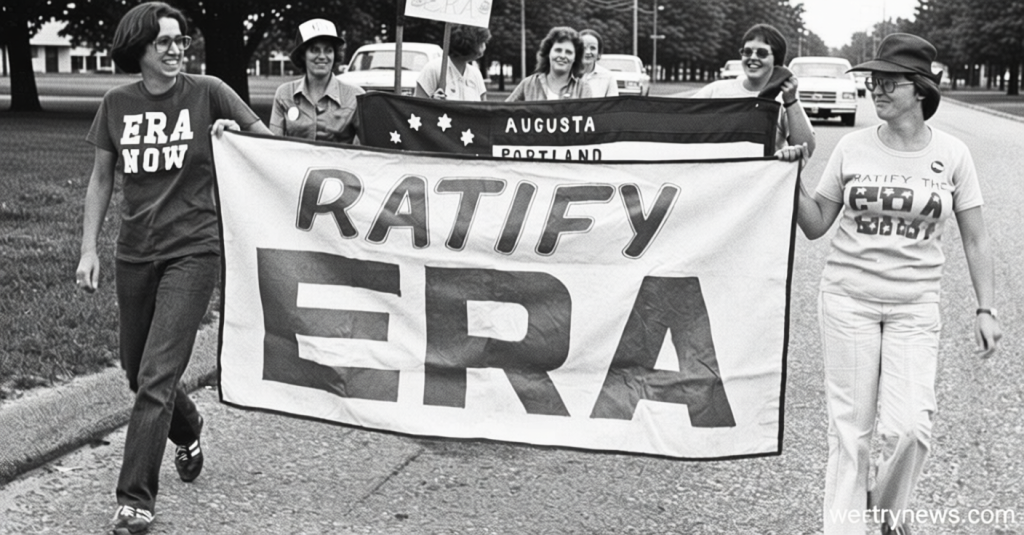
The Equal Rights Amendment: A Promise Unfulfilled
Wertynews.com – The Equal Rights Amendment, a succinct 24-word statement, asserts that “equality of rights under the law shall not be denied or abridged by the United States or any state on account of sex.” It was crafted by Alice Paul, a key figure in securing women’s suffrage in 1920. Despite its brevity, the amendment sparked a decades-long struggle for ratification.
A Decades-Long Struggle
Paul first introduced the ERA to Congress in 1923, but it took nearly half a century for the amendment to gain momentum. By 1972, the push for passage had intensified, with advocates hoping for swift approval. However, the process of securing ratification by three-quarters of the states proved unexpectedly challenging.
“Why? Because it was based on justice and common sense and fairness,” said Letty Cottin Pogrebin, a feminist writer and founder of Ms. Magazine. At 87, she recalled her belief that the country would embrace equality by 1975.
Opposition emerged swiftly, led by conservative activist Phyllis Schlafly, who argued that the ERA would undermine traditional family roles. “Women do have ambition and work hard, but most choose to focus on building their family,” she claimed in 1983.
The amendment faced a critical deadline in 1982, yet ratification stalled at 35 states—three short of the 38 needed. While the ERA did not pass, progress continued in other areas. For instance, Robin Pogrebin, a veteran New York Times journalist, noted that her generation benefited from the groundwork laid by earlier activists.
A New Generation’s Perspective
Robin Pogrebin, 61, reflected on how her career in the 1960s differed from her granddaughter Maya Klaris’s experiences. “My generation had the advantage of my mother’s efforts breaking barriers,” Robin said. “We didn’t feel the need to protest as aggressively as before.”
Maya Klaris, 27, works in finance and has no immediate plans to prioritize family life. “I never thought about being a woman in terms of my career,” she admitted. “But when I heard about the ERA, it felt like a question: Do women not have equal rights under the law?”
Even with the amendment’s ratification in 2020 by Virginia, the deadline had already expired. This left the constitutional guarantee of gender equality still unratified, despite gains in reproductive rights, pay equity, and military opportunities.
The Road Ahead
While the ERA remains unenacted, its legacy endures. The amendment’s journey highlights ongoing debates about how to define and achieve equality. As the movement evolves, new generations continue to navigate the same challenges, sometimes in different ways.
For more insights, watch an exclusive conversation with Letty Cottin Pogrebin, Robin Pogrebin, and Maya Klaris. Story produced by Marty Raffalli, edited by Carol Ross.
See also: – 2023: Senate fails to advance Equal Rights Amendment – The Equal Rights Amendment is stalled, will it ever become law? – A tribute to monumental women – How suffragists finally won the right to vote for women
Join CBS for “The Great American Block Party 250,” a primetime special on Saturday, July 4, hosted by Tony Dokoupil and Nischelle Turner. Featuring live music, nationwide celebrations, and a historic fireworks display in Washington, D.C., the event airs at 8 p.m. ET on CBS and streams on Paramount+ and CBS News 24/7.