
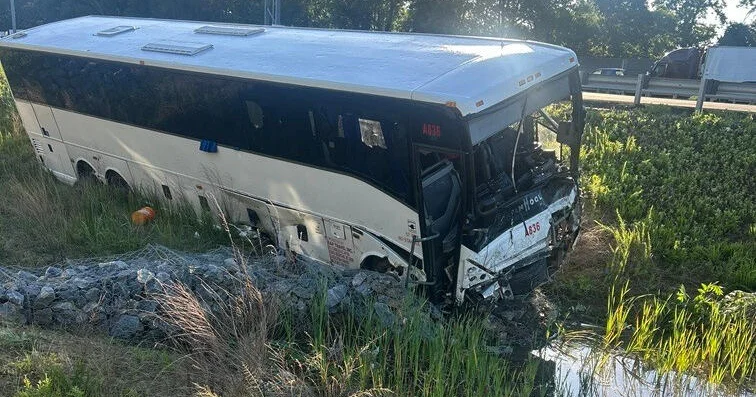
After Deadly Virginia Bus Crash, Federal Investigators Examine Company’s Ties to Other Carriers
Wertynews.com – The recent fatal bus crash in Virginia has sparked a federal investigation into the company’s connections with other transportation firms, with authorities seeking to uncover whether a pattern of safety lapses exists across its network. The incident, which occurred on May 29, has drawn attention to E&P Travel Inc., a company linked to the tragedy, and its potential role in similar accidents. This probe follows a 2024 crash in North Carolina, where an E&P Travel bus collided with another vehicle at a construction site, injuring nine people. The Federal Motor Carrier Safety Administration (FMCSA) is collaborating with other agencies to assess whether the company’s operations have repeated failures in compliance with safety regulations.
The Virginia Crash and Its Aftermath
The May 29 crash on I-95 in Stafford County, Virginia, resulted in five deaths and multiple injuries, sending shockwaves through the local community and raising questions about the company’s safety practices. According to preliminary reports, the bus struck stalled traffic, leading to a catastrophic collision. This event has intensified scrutiny of E&P Travel Inc. and its broader network, as investigators look into whether the company’s restructuring under new names has allowed it to evade accountability for past violations. The Federal Motor Carrier Safety Administration (FMCSA) is now analyzing the company’s history to determine if its safety record is compromised by its ties to other carriers.
“The ability to rebrand allows companies to hide their missteps until an accident forces them back into the spotlight,” said a safety consultant familiar with the case. This strategy, often criticized as a regulatory loophole, enables firms to maintain operations while concealing past infractions. The FMCSA’s current investigation aims to identify if E&P Travel Inc. is part of a larger pattern of companies that repeatedly breach safety standards.
Patterns of Safety Oversight Evasion
Industry experts have highlighted a concerning trend of “chameleon carriers” — businesses that operate under new names but retain the same infrastructure, staff, and operational practices. These companies are frequently cited for repeated violations, yet they manage to sidestep stricter penalties by restructuring. CBS News has documented over 10,000 such cases across the country, underscoring how this practice can obscure accountability. The recent Virginia crash has reignited interest in this phenomenon, as investigators dig deeper into E&P Travel Inc.’s affiliations with other transportation firms.
For instance, E&P Travel Inc. has been associated with Super Bus Inc., a company previously flagged for speeding violations. Despite these connections, E&P Travel Inc. was recently awarded a “satisfactory” safety rating by the FMCSA in April 2024, a decision that has drawn criticism. The disparity between the company’s rating and its involvement in fatal accidents highlights the need for more rigorous oversight. Officials are now examining whether the FMCSA’s current evaluation system adequately reflects the risks posed by such interconnected carriers.
Company’s History and Legal Implications
E&P Travel Inc., established in November 2023, operates with a headquarters listed as a residential apartment, raising eyebrows about its transparency. CEO Shuo Liu, who has not been reached for comment, is at the center of the investigation. The company’s 2023 filings with the FMCSA identify Joyce Gao as an officer, but records show Gao is also listed as CEO of Super Bus Inc. This overlap has led to speculation about shared management and operational practices between the two firms. Ronghai Gao, who disputes the connection, claims Joyce Gao was a bookkeeper at Super Bus until April 2024, though he remains unclear about the exact relationship.
Legal repercussions are mounting for the company’s driver, Jing S. Dong, who faces five felony charges of involuntary manslaughter. The crash has not only impacted the families of the victims but has also fueled public concern about bus safety in the region. As the investigation continues, it is expected to reveal more about the company’s compliance history and its ties to other carriers. This case may serve as a catalyst for reforms in how federal regulators monitor transportation companies, particularly those that rebrand to avoid scrutiny.
Broader Implications for the Bus Industry
The Virginia bus crash and its subsequent investigation are part of a larger conversation about safety standards in the transportation sector. Critics argue that the current system allows companies to repeatedly violate rules without facing significant consequences. For example, E&P Travel Inc.’s history of speeding violations, as noted in federal records, demonstrates how minor infractions can accumulate into major incidents. This has prompted calls for stricter enforcement and more frequent audits, especially for companies with a history of rebranding.
“Companies like E&P Travel Inc. exploit regulatory gaps by changing names and operations, but the root issues remain the same,” said a transportation safety analyst. The FMCSA is now under pressure to address these patterns, which could have prevented the Virginia crash. As the investigation unfolds, it may set a precedent for how federal agencies handle similar cases, potentially reshaping the way carriers are held accountable for their actions.
The ongoing probe into E&P Travel Inc. and its network underscores the importance of transparency in the transportation industry. With over 10,000 chameleon carriers documented nationwide, the risk of repeated safety lapses is significant. This case has also raised awareness among the public, with many questioning whether federal oversight is sufficient to prevent such tragedies. As the FMCSA continues its investigation, the findings could lead to policy changes that improve safety standards and reduce the likelihood of future crashes linked to these interconnected companies.