
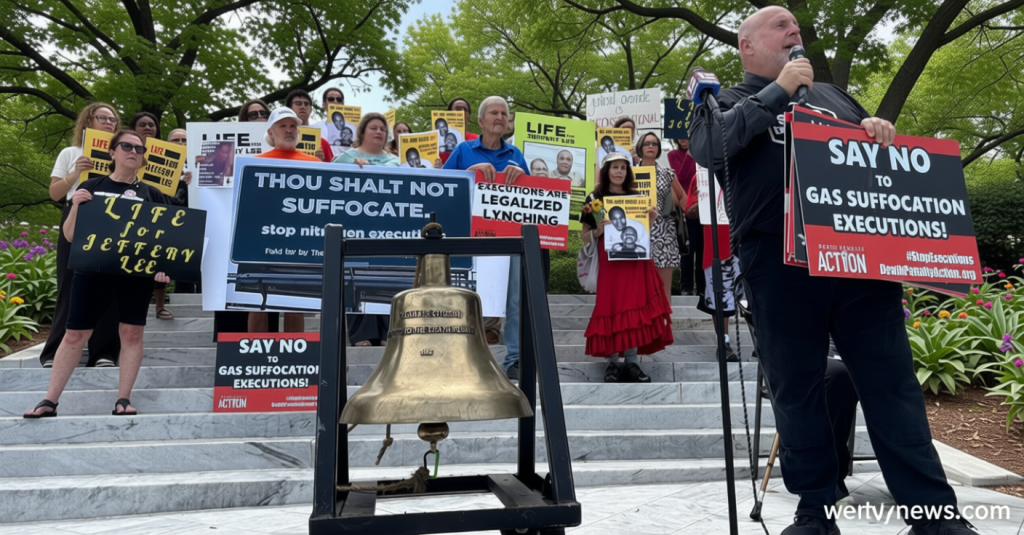
Alabama Inmate’s Nitrogen Gas Execution Faces Supreme Court Appeal
Wertynews.com – Jeffrey Lee, a 49-year-old death row prisoner in Alabama, is poised to face execution via nitrogen hypoxia tonight, with the outcome dependent on the U.S. Supreme Court’s decision in a last-minute appeal. The state’s legal team has contested a federal judge’s ruling that declared the method unconstitutional, as the execution date approaches. This case highlights the ongoing debate over whether nitrogen gas constitutes a humane alternative to traditional lethal injection, or if it introduces new ethical concerns in capital punishment.
A High-Stakes Legal Challenge
The appeal filed by Alabama’s Attorney General, Steve Marshall, aims to reverse a Tuesday ruling by U.S. District Judge Emily Marks, who had temporarily halted the use of nitrogen gas for Lee’s execution. The judge argued that the method violates the Eighth Amendment due to its potential for prolonged suffering, as the inmate loses consciousness slowly. Alabama’s legal argument emphasizes that nitrogen hypoxia is a reliable and swift method, unlike firing squad executions, which lack standardized procedures. The state’s position hinges on the Supreme Court’s agreement that the method meets constitutional standards.
“The governor remains prepared to move forward with the planned execution,” stated a spokesperson for Alabama Governor Kay Ivey’s office, as the state “continues to defend its execution protocol in the courts.” The spokesperson highlighted that nitrogen gas provides a consistent and painless method, contrasting it with other execution techniques that may vary in effectiveness.
The Mechanics and Controversy of Nitrogen Hypoxia
Nitrogen hypoxia involves administering pure nitrogen gas to an inmate, depriving them of oxygen and leading to unconsciousness and eventual death. While proponents argue it is a humane method, critics contend that the process can cause distress, such as gasping, trembling, and irregular breathing, before the inmate becomes insensate. The method’s proponents, including Alabama’s legal team, claim it is quick and reliable, whereas opponents describe it as a violent and experimental form of execution. The debate underscores broader questions about the definition of “humane” in capital punishment.
Historical Context and Judicial Override
Jeffrey Lee’s journey to the execution chamber began in 1998, when he was convicted of double murder and store robbery. His original sentencing by a jury was a life sentence, but a judicial override by the trial judge placed him on death row. This practice, which allowed judges to disregard jury recommendations, was common in Alabama until it was abolished in 2017. Lee’s case now represents a new chapter in the state’s approach to execution, with nitrogen gas becoming the first alternative method since the switch from lethal injection in 2024.
Global and Domestic Reactions to the Method
The use of nitrogen gas in executions has drawn criticism from international human rights advocates, who view it as an inhumane innovation. Before Alabama’s implementation in 2024, the technique had never been applied in the United States. Since its adoption, eight inmates have been executed with nitrogen gas, including seven in Alabama and one in Louisiana. Supporters argue that the method offers a viable option when lethal injection is unavailable or controversial, while detractors stress the need for more transparency and research into its effects.
“Nitrogen gas execution is a step forward in ensuring a painless death,” said Alabama’s legal team in their appeal. However, opponents like the American Civil Liberties Union (ACLU) argue that the method’s lack of established protocols raises questions about its reliability and the rights of the condemned.
The Future of Capital Punishment in Alabama
If the Supreme Court upholds the federal judge’s ruling, Alabama may face a significant setback in its use of nitrogen gas for executions. The decision could influence other states considering similar alternatives, potentially reshaping the landscape of capital punishment in the U.S. Meanwhile, the case has sparked discussions about the role of judicial oversight in execution methods, with some arguing that the Supreme Court should intervene to ensure consistency in constitutional standards. As the clock ticks down to tonight’s execution, the legal battle serves as a pivotal moment in the ongoing debate over the morality and efficacy of modern execution techniques.