
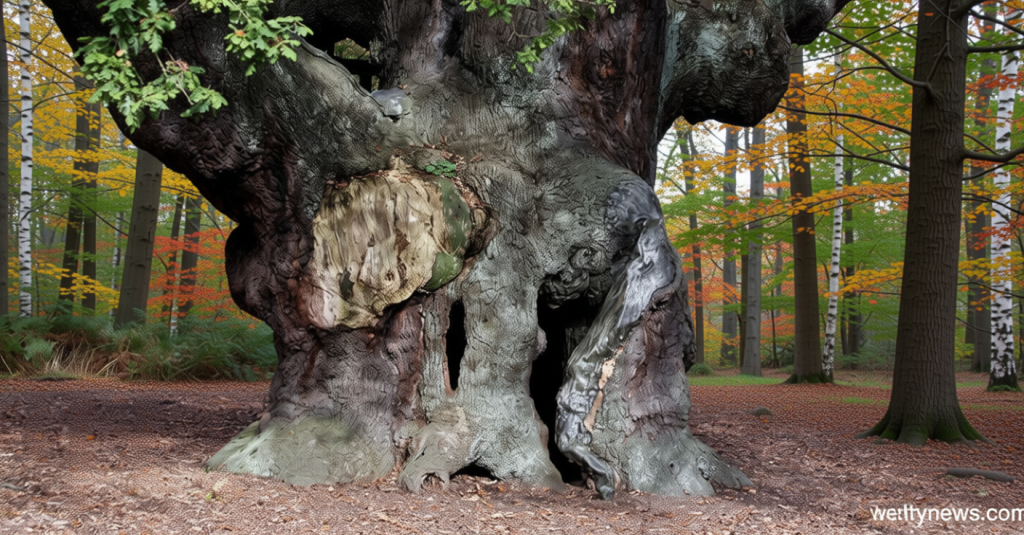
1,200-Year-Old Robin Hood Oak Dies, Eliciting Grief
Ancient Symbol of Legend Faces Final Chapter
Wertynews.com – The 1,200-year-old Robin Hood oak tree, a centuries-old symbol of the legendary outlaw, has succumbed to its final fate, according to the Royal Society for the Protection of Birds (RSPB). This iconic tree, located in Sherwood Forest, Nottinghamshire, has been a focal point for history enthusiasts and nature lovers alike. Its decline was marked by the absence of new leaves this spring, signaling the end of its life. The announcement has sparked widespread sadness, as the tree has long been regarded as a living piece of folklore and ecological heritage.
The Tree’s Historical and Cultural Legacy
Known as the Major Oak, this tree has been deeply intertwined with the story of Robin Hood since its mention in a 1790 book by Major Hayman Rooke. The narrative describes how the outlaw and his band of Merry Men allegedly hid from the sheriff’s forces beneath its sprawling canopy. Over time, the tree became a symbol of resilience and freedom, attracting thousands of visitors annually. Its roots, stretching over a mile, once anchored the forest’s ecosystem, providing habitat for countless species of flora and fauna.
“The tree’s failure to sprout this season is heartbreaking for everyone,” said Hollie Drake of the RSPB in a statement.
The loss of the Major Oak represents more than just the death of a single tree—it signifies the fading of a tangible connection to a historical figure whose stories have shaped British culture. The RSPB highlighted that the tree was a UNESCO-listed site, drawing attention to its role as a natural landmark and its significance in local and national history.
Conservation Efforts and Challenges
Despite decades of protective measures, including a fence erected in the 1970s to limit human impact, the Major Oak faced persistent threats. Visitors, drawn to its historical allure, often trampled the surrounding soil or placed heavy objects near its base, disrupting its root system. Conservationists also noted that cables and poles installed to support its massive structure may have contributed to its decline. Additionally, climate change has exacerbated the problem, with prolonged droughts and extreme weather events weakening the tree’s ability to absorb nutrients and retain moisture.
Efforts to revive the tree included regular monitoring, pruning, and soil analysis, but these interventions proved insufficient. The tree’s age and size made it particularly vulnerable to environmental stressors. While some hope to preserve its memory through saplings planted in its honor, the RSPB stressed that the loss is a stark reminder of the fragility of ancient woodlands. “Ancient trees like the Major Oak are the conservation white rhinos of the UK,” emphasized Ed Pyne of the Woodland Trust. “Their survival is critical for biodiversity and cultural identity.”
Broader Impact on Ecosystem and History
The Major Oak’s demise has raised concerns about the health of Sherwood Forest’s ancient trees. These oaks, some over 1,000 years old, play a vital role in maintaining the forest’s biodiversity, offering shelter to wildlife and stabilizing the soil. The loss of one such tree could have cascading effects on the local ecosystem. Historically, Sherwood Forest’s oaks have also been instrumental in Britain’s naval and architectural history. For example, timber from similar trees in the region was used in the construction of St. Paul’s Cathedral in London and the hulls of ships in Admiral Horatio Nelson’s fleet during the late 18th century.
Locals and historians have expressed deep emotional ties to the tree, with many describing it as a “living legend.” Its presence in the forest was not only a testament to Robin Hood’s tales but also a reminder of the region’s natural and cultural roots. The RSPB noted that the tree had survived numerous challenges, from storms to human activity, but its recent death underscores the urgency of protecting ancient woodlands. “This tree’s legacy will endure through saplings and the stories it inspired,” Drake added, emphasizing the importance of preserving such landmarks for future generations.
Future Steps and Commemoration
In response to the tree’s death, conservationists have called for increased efforts to protect remaining ancient oaks and restore the forest’s natural balance. Plans are underway to plant new saplings in the area, ensuring the Major Oak’s spirit lives on. Additionally, a memorial event is being organized to honor its contributions to both history and ecology. The tree’s remains will be preserved for study, offering insights into its age and the conditions that led to its decline.
As the final chapter of the Major Oak’s life is written, its story serves as a poignant reminder of the delicate interplay between nature and human history. While the tree is gone, its cultural and environmental impact remains profound. The RSPB’s statement underscores the need for greater awareness and action to safeguard ancient trees, which are not only ecological keystones but also irreplaceable symbols of our shared heritage. The Major Oak’s passing marks a significant moment for Sherwood Forest and its devoted admirers, who will now carry its legacy forward in new and meaningful ways.