
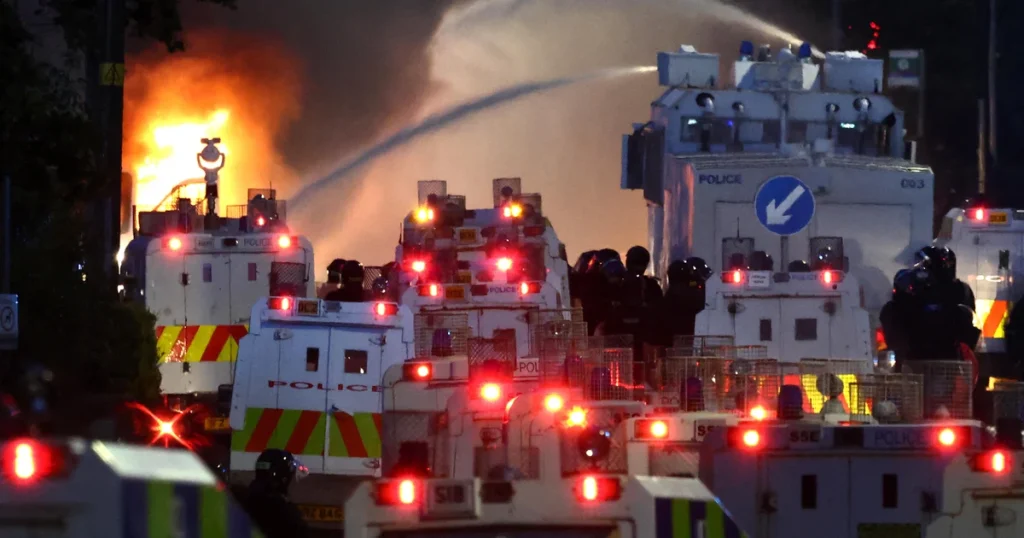
Belfast protests erupt again after stabbing as police deploy water cannons
Wertynews.com – Belfast protests erupted again after a violent knife attack, escalating tensions in the city as demonstrators took to the streets for the second night in a row. The unrest, which followed the stabbing incident, saw police using water cannons to control crowds, while rioters hurled bricks, rocks, and bottles at officers. The chaotic scenes included the setting of fires and the use of dismantled fencing as makeshift shields, reflecting the deepening divide among locals.
Suspect Appears in Court, Charged with Attempted Murder
Hadi Alodid, a 30-year-old Sudanese man, was brought before Belfast Magistrates’ Court on Wednesday. He was charged with attempted murder after allegedly blinding Stephen Ogilvie in the left eye during a stabbing that left the victim critically injured. Alodid also faced accusations of possessing a knife and threatening a radiographer who was treating a hand wound from the attack.
“I’ve killed someone, I don’t know if they are dead,” Alodid reportedly told hospital staff. “I will kill you.” He declined legal representation through an Arabic interpreter and did not enter a plea during his appearance, leaving the court to assess the gravity of the charges against him.
Violence Sparks Fears of Ethnic Tension
Residents across Belfast expressed alarm over the violence, with one Congolese-born individual describing the night as “horrific.” Anselme Shima, who has lived in the city for nearly a decade, shared his concerns about the attack disrupting community safety. “We don’t know what to do. I’m scared. Seeing this, I’m wondering if I’m next,” he said, highlighting the growing fear among ethnic minority communities.
On Tuesday, masked individuals had already targeted homes they believed housed immigrants, setting fire to vehicles and forcing families to seek refuge. Over two dozen people were left without shelter, and several were rescued by firefighters. Chief Constable Jon Boutcher of the Police Service of Northern Ireland emphasized that the violence affected families from all communities, stating, “These were families from across communities caught up in this vile behavior.”
Community Reaction and Political Condemnation
Two local men, who requested anonymity, shared their mixed reactions to the violence. While they were upset by the stabbing video, they criticized the destruction on the streets. “The worrying thing is that people are kind of surprised, but not surprised,” one told CBS News. He referenced the Southampton murder of Henry Nowak, which had earlier sparked anti-immigration protests, suggesting a pattern of frustration among some groups.
Politicians from both sides of Northern Ireland’s power-sharing government condemned the unrest. Sinn Féin’s Michelle O’Neill called the events “thuggery,” while Democratic Unionist Party’s Emma Little-Pengelly described the violence as “utterly wrong.” Both leaders stressed that the attack should not be used to divide communities, urging calm and dialogue.
“We want to make it absolutely clear that overnight unrest is not welcome,” said Ogilvie’s family. “Peaceful protest is the only way forward. We depend on migrants to make our country work.” Their statement underscored the emotional impact of the incident, with calls for unity in the face of rising tensions.
Impact on Public Services and Future Concerns
The Belfast protests erupted again after the stabbing, prompting public transport operators to announce early service suspensions due to anticipated crowds. With 200 additional officers deployed, the Police Service of Northern Ireland (PSNI) sought support from other forces to manage the situation. The incident, captured on video and shared widely online, has reignited debates about immigration and community cohesion in the region.
Experts warn that the Belfast protests erupted again after the stabbing could signal a shift in public sentiment. “This isn’t just a one-off event; it’s part of a broader narrative,” said Dr. Fiona Connolly, a sociologist specializing in Northern Ireland. “The stabbing has become a catalyst for more aggressive expressions of frustration, which may not be easily contained.”
As the city grapples with the aftermath, community leaders are urging for a balanced approach. “We need to address the concerns of all residents, not just those of the minority,” said a spokesperson for the Belfast Community Trust. “The Belfast protests erupted again after the stabbing, but they should serve as a reminder of the shared values that unite us.”