
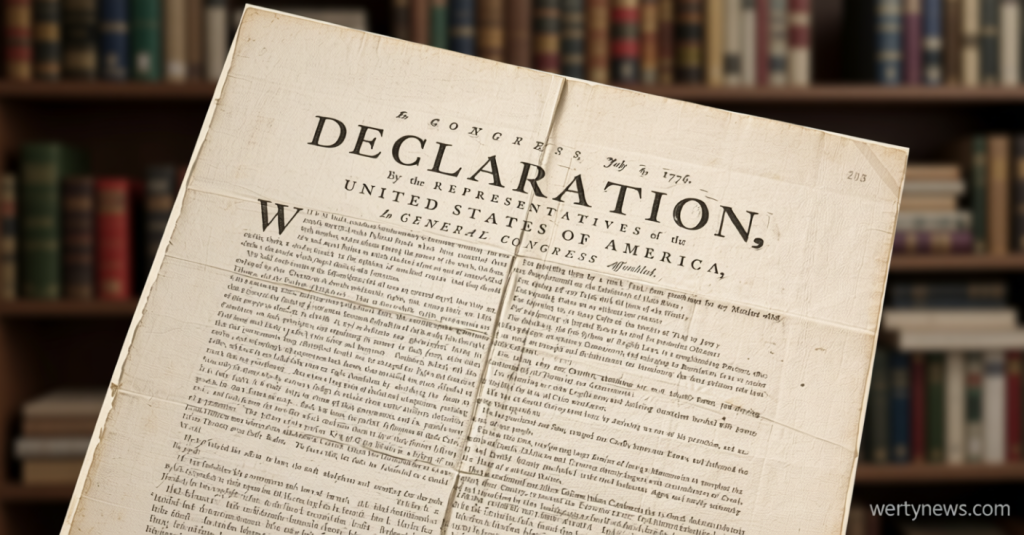
Rare 1776 Declaration of Independence Copy Discovered in UK by Volunteer
Wertynews.com – A vanishingly rare copy of the Declaration of Independence, one of only 11 known surviving versions of the iconic document, has been unearthed in the United Kingdom by a dedicated volunteer. The find, labeled the “Exeter Declaration,” has captured the attention of historians and archivists alike, as it is the sole known copy outside the United States. This rare artifact was recently rediscovered at the National Archives in London, shedding new light on the document’s journey from the American Revolution to British shores.
The Historical Significance of the Exeter Declaration
The Exeter Declaration, believed to have been printed in Exeter, New Hampshire, in 1776, played a crucial role in spreading the revolutionary message across the Atlantic. Unlike the original signed version, this copy was produced for distribution, often carried on ships to ensure its reach. The National Archives noted that it was seized from the American privateer ship Dalton on Christmas Eve of that year, during a dramatic 7-hour pursuit off the coast of Portugal by the British Royal Navy vessel HMS Raisonable. This event marks a pivotal moment in the document’s history, highlighting its use as a tool of resistance during the early stages of the American Revolution.
Historians emphasize the Exeter Declaration’s unique place in the global narrative of the Declaration of Independence. While most surviving copies were preserved in the U.S. or housed in private collections, this one’s presence in the UK offers a rare glimpse into how the revolutionary ideals traveled beyond the New World. The document’s journey from the hands of American sailors to British archives underscores the interconnectedness of colonial history and the enduring impact of the Declaration’s message.
How the Volunteer Uncovered the Treasure
Michael Scurry, a volunteer at The National Archives, made the extraordinary discovery while organizing a box of correspondence. Scurry’s initial curiosity led him to examine the document, which had been cataloged as “another paper” for years. His keen eye and historical insight prompted him to alert his supervisor, ultimately leading to its recognition as a priceless find. “I called over to my boss and said, ‘I think you need to come and have a look at this,'” Scurry recounted, capturing the moment of realization that would redefine the archive’s holdings.
The National Archives has since highlighted the document’s condition, noting that it was remarkably well-preserved despite its age. Dr. Graham Moore, a curator at the institution, described the Exeter Declaration as a “tangible link to the revolutionary era,” explaining that its existence demonstrates how the Declaration was not just a political statement but a practical tool for mobilizing support. The document’s inclusion in the captured materials of the Dalton suggests it was valued for its symbolic and strategic importance, even in the midst of conflict.
Experts speculate that the Exeter Declaration may have been part of a broader effort to disseminate the revolutionary ideals among British audiences. Its presence in the archives has since sparked renewed interest in the document’s role as a historical artifact, with scholars eager to study its text and context. The National Archives has announced plans to display the copy in a special exhibition, allowing the public to witness this vanishingly rare piece of history up close.
The Broader Implications of the Discovery
The discovery of the Exeter Declaration has broader implications for understanding the American Revolution’s global influence. It serves as a reminder that the fight for independence was not confined to American soil, as revolutionary materials were transported across the Atlantic to inspire and inform. The document’s presence in the UK also raises questions about how British officials perceived the American cause and whether they sought to preserve or study its significance.
Additionally, the find underscores the importance of volunteer efforts in uncovering hidden treasures within archival collections. Scurry’s contribution highlights how individuals, even without formal expertise, can play a vital role in historical preservation. The National Archives has praised his dedication, noting that such discoveries often rely on the keen observations of volunteers who work tirelessly to sort through centuries of records.
As the Exeter Declaration takes its place in the UK’s national collection, it continues to intrigue researchers and history enthusiasts. Its rediscovery not only adds to the historical record but also reinforces the value of ongoing archival work. The document’s rarity and unique journey make it a critical addition to the global understanding of the Declaration of Independence’s legacy, ensuring its place in the annals of history for generations to come.