
Boston Dynamics’ AI-Driven Humanoid Robot Embarks on Factory Labor Journey
Wertynews.com – Originally published on January 4, 2026, this revised report highlights the progress of Boston Dynamics’ groundbreaking humanoid robot, Atlas. As artificial intelligence continues to evolve, human-like robots are transitioning from experimental labs to industrial settings, reshaping manufacturing landscapes. With concerns mounting over AI’s potential to replace human labor, a global competition is emerging among tech giants and innovators to develop machines capable of performing complex tasks traditionally reserved for workers. Among these pioneers, Boston Dynamics stands out, backed by Hyundai’s 90% ownership stake and driven by cutting-edge advancements in robotic intelligence.
A Factory of the Future, or the Future of the Future?
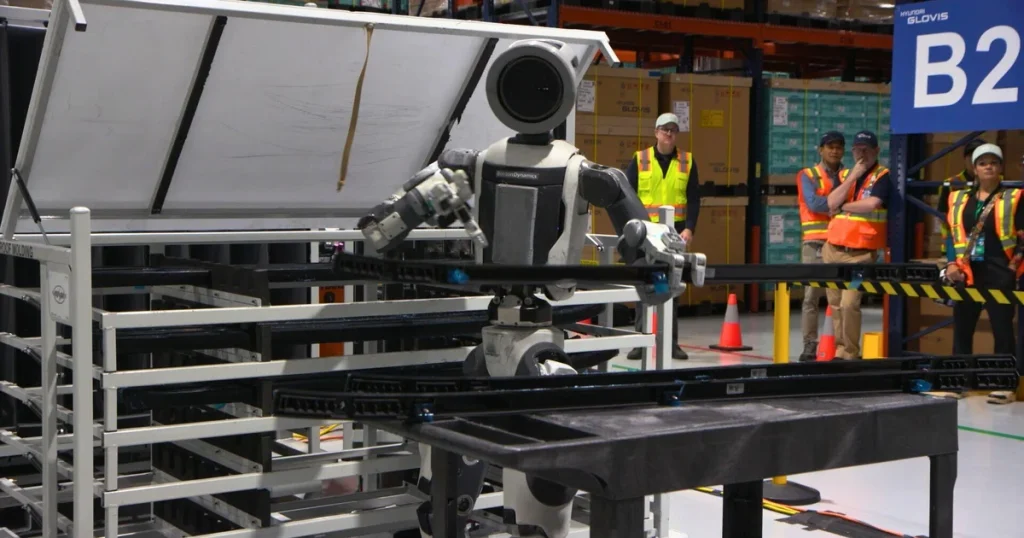
Hyundai’s state-of-the-art automobile plant serves as a testament to modern automation, where over 1,000 robots collaborate with nearly 1,500 humans to execute precision-driven tasks like lifting, stamping, and welding. While this setup may appear futuristic, the next phase of innovation unfolded in a secluded parts warehouse, where a new frontier of robotic capability was being tested. There, Boston Dynamics’ Atlas—standing at 5’9″ and weighing 200 pounds—demonstrated its AI-powered adaptability in real-world conditions.
“Every time I see it, I just can’t believe what my eyes are seeing,” remarked Bill Whitaker, reflecting on Atlas’s strides toward practical use. “Is this the first time Atlas has been out of the lab?”
Zack Jackowski, lead developer of the project, confirmed, “This is the first time Atlas has been out of the lab doing real work.” Jackowski, who holds two mechanical engineering degrees from MIT, has spent a year refining Atlas’s abilities to meet Hyundai’s operational needs. Earlier in the year, the team showcased their efforts at Boston Dynamics’ headquarters, where the robot learned essential skills through guided practice and AI-driven trial-and-error.
From Hydraulic Leaps to Electric Intelligence
When 60 Minutes last visited Boston Dynamics in 2021, Atlas was a bulky, hydraulically powered prototype capable of running and jumping. Its movements were dictated by pre-programmed algorithms, a far cry from its current form. Upon revisiting this fall, the robot had transformed: a sleek, all-electric design now housed an AI brain powered by Nvidia’s advanced microchips. This upgrade enables Atlas to perform tasks autonomously, such as sorting roof racks for assembly lines, without direct human intervention.
“It sounds almost impossible, doesn’t it?” Bill Whitaker asked, expressing awe at the robot’s capabilities. “A little bit,” Jackowski replied, acknowledging the shift in robotic design over the years.
Learning by Doing, Not by Code
Scott Kuindersma, former head of robotics research, emphasized that programming robots now involves a blend of teaching, demonstration, and machine learning. “We’ve moved beyond manual coding to a system where the robot learns through experience,” he explained. This approach has allowed Atlas to master movements once deemed too complex for machines. Kuindersma, who proudly wore a robot-themed shirt during the visit, noted the enthusiasm within the team as they witnessed the robot’s growing autonomy.
“I remain extremely excited about where we are in the history of robotics,” Kuindersma said, “but we see that there’s so much more we can do.” He added, “Teaching robots through AI has proven to be one of the most effective methods.”
In supervised learning scenarios, human operators like Kevin Bergamin use virtual reality headsets to guide Atlas’s actions, step by step, until the robot internalizes the process. This hybrid model of human oversight and machine adaptation underscores Boston Dynamics’ commitment to bridging the gap between robotic potential and industrial application. As the technology matures, the line between human and machine in the factory setting is expected to blur further, marking a pivotal chapter in automation’s evolution.