
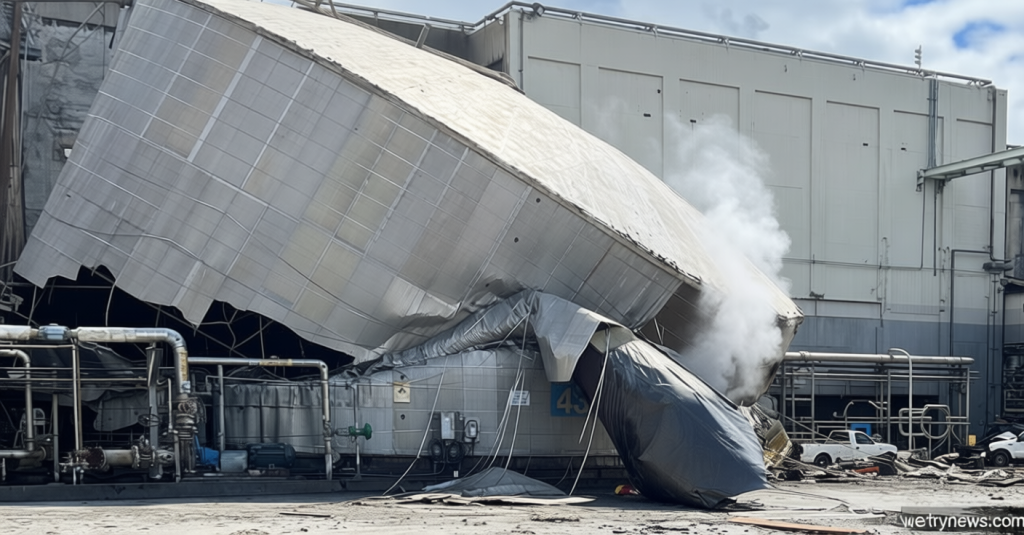
7 of 9 Bodies Recovered After Chemical Tank Implosion at Washington State Paper Mill
Wertynews.com – Following a catastrophic chemical tank implosion at a pulp and paper mill in southern Washington state, officials reported on Friday that seven of the nine missing workers had been retrieved from the wreckage. The incident, which occurred on Tuesday at the Nippon Dynawave Packaging Co. facility in Longview—a city near the Oregon border—has left authorities and families in a state of suspense as they continue efforts to locate the remaining two individuals. Two workers were initially declared dead, raising the total death toll to 11, with the search for the final two bodies still ongoing. The recovery process has been challenging, as responders describe the scene as one of intense complexity and industrial danger.
Details of the Implosion and Recovery Efforts
The tank that exploded was part of the mill’s operations and contained white liquor, a critical component in the paper and pulp manufacturing process. This mixture of sodium hydroxide and sodium sulfide is typically used to break down wood fibers, but its sudden release during the implosion created a hazardous environment. According to preliminary reports, the tank had a capacity of approximately 900,000 gallons and was about two-thirds full at the time of the accident. Emergency crews have been working tirelessly to assess the damage and extract survivors from the debris.
On Thursday, six bodies were recovered from the area where employees commonly gather before and after shifts. This location, described as a central hub for workers, was severely impacted by the explosion, with collapsed structures and exposed electrical wiring complicating the search. The Longview Fire Department’s Battalion Chief Matt Amos noted the scene’s complexity, stating that crews must rotate in and out of the site while undergoing decontamination procedures each time they exit. “The conditions are very challenging,” he explained, emphasizing the need for caution amid the hazardous materials still present.
“We work in a highly hazardous atmosphere and a highly hazardous industry. We approach it with the utmost care in everything that we do. I’ll let the facts speak for themselves.”
Despite the grim situation, officials remain hopeful that the remaining two bodies will be found soon. The search team has not yet determined a timeline for the final recovery, as the wreckage continues to be a site of ongoing risk. Meanwhile, more than a dozen individuals were injured in the incident, though the severity of their injuries and the number of affected workers remain unclear. Some of the injured were transported to the Legacy Oregon Burn Center in Portland, where medical professionals are assessing their conditions.
Environmental Impact and Water Safety Measures
Environmental concerns have also emerged as a result of the explosion. The tank’s rupture caused a slow leak of white liquor into a network of nearby ditches that flow over a key water source for the city’s residents. While the immediate danger to air quality appears to have subsided, the leakage into the ditch system has raised questions about potential contamination of the local water supply. The Environmental Protection Agency (EPA) coordinator, Brooks Stanfield, addressed these worries on Thursday, stating that no hydrogen sulfide—a toxic gas associated with the chemical—has been detected in the surrounding air.
Stanfield clarified that some of the leaked material has reached the Columbia River, which is a significant waterway in the region. “The understanding is it was very limited,” he noted, adding that the river is currently safe for recreational activities such as fishing and swimming. However, dead fish were discovered in the contaminated ditch complex, and authorities expect to find more as they continue monitoring the area. “We will keep identifying the impact until the system can be safely flushed,” Stanfield said, outlining the agency’s strategy for mitigating environmental harm.
“The water is safe to drink for now, and there is no cause for concern.”
Public Works Director Chris Collins assured the public that the city’s drinking water remains unaffected. He explained that the water is sourced from a deep aquifer, 200 feet below the surface, which is well-protected from surface-level pollutants. To further ensure safety, the department has begun using fire hydrants to introduce fresh water into the ditch system, aiming to dilute the chemicals and eventually flush them into the Columbia River. This dual-step approach involves both immediate containment efforts and long-term environmental monitoring.
Company Response and Ongoing Operations
Nippon Dynawave’s director of support services, Brian Wood, provided updates on the mill’s current status. He stated that the facility was fully shut down following the explosion, with only “some critical infrastructure” still operational and “minimum staffing” in place. The company has also made arrangements to compensate workers who are unable to return to their jobs, a measure Wood said will continue until further notice. “We are prioritizing the well-being of our employees and ensuring they receive the support they need,” he added.
Wood acknowledged the dangers of the industry but emphasized the company’s commitment to safety. “We operate in an environment where risks are inherent, but our protocols are designed to minimize those risks,” he said. While the mill is currently in a state of emergency, Wood suggested that the situation may stabilize in the coming days as authorities and teams work to secure the site and assess long-term impacts. The company’s focus remains on both human and environmental recovery, with plans to communicate regularly with the public about the progress.
Local authorities have estimated that approximately 25,000 gallons of the chemical mixture remain inside the damaged tank, with leakage ongoing. Amos confirmed that the tank’s condition has not changed significantly since the incident, highlighting the persistent threat it poses. The situation continues to evolve, and officials urge continued vigilance as they work to complete the recovery and clean-up efforts. For now, the community watches closely, hoping for clarity on the full scope of the tragedy and its lasting effects.
As the investigation unfolds, questions remain about the cause of the implosion and how it could have occurred during a shift change. The timing of the accident, which coincided with the transition of personnel, has sparked discussions about safety procedures and potential oversight. While the immediate focus is on recovering the missing bodies and ensuring environmental safety, the incident serves as a stark reminder of the risks associated with industrial operations. The local community, along with workers and families, awaits further details to understand the full impact of the event and how to prevent similar disasters in the future.