
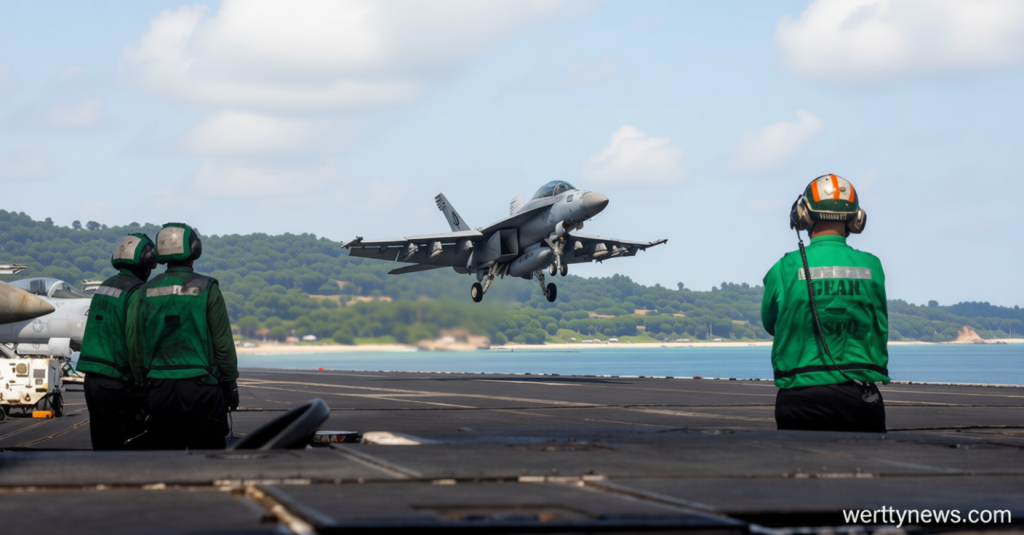
Live Updates: Iran Fires Missile at Kuwait After U.S. Strikes, as Trump Says Regime ‘Negotiating on Fumes’
Wertynews.com – Last updated on May 28, 2026, at 11:21 AM EDT by CBS News
U.S. Targets Iran’s Strait Authority with Sanctions
On May 28, 2026, the U.S. Treasury Department sanctioned Iran’s Persian Gulf Strait Authority (PGSA), the entity responsible for collecting tolls from vessels navigating the Strait of Hormuz. The move was confirmed by Secretary Scott Bessent, who highlighted the agency’s diminished role in regional operations.
“Iran’s Persian Gulf Strait Authority is a joke, and today Treasury has sanctioned it,” Bessent stated on X. “We have warned any corporate or state entities against paying tolls or disguising them as aid payments.”
The PGSA’s responsibilities include managing maritime traffic through the strategic waterway, which is vital for global oil exports. By targeting the agency, the U.S. aims to disrupt Iran’s ability to generate revenue while signaling broader economic pressure. Bessent emphasized that the sanctions were a direct response to Iran’s perceived attempts to maintain control over the strait through financial means.
Trump’s Assertive Stance on Hormuz Control
During a Cabinet meeting on Wednesday, President Trump took a firm position on the Strait of Hormuz, declaring that no entity should claim authority over the region. His remarks underscored the administration’s commitment to ensuring the waterway remains a U.S. priority.
“Nobody’s going to control it,” Trump insisted. “We’re going to watch over it. We’ll watch over it. But nobody’s going to control it. That’s part of the negotiation we have. They would like to control it. Nobody’s going to control it.”
Trump’s comments reflected a strategic shift toward direct oversight of the strait, rather than relying on intermediaries. He framed the issue as a battle between American dominance and Iranian ambitions, suggesting that the U.S. would take decisive action if negotiations stalled. The administration’s approach has been to combine economic pressure with military readiness, ensuring that Iran cannot consolidate its influence without U.S. consent.
Operation Economic Fury’s Impact on Iranian Economy
Secretary Bessent also praised the effectiveness of the U.S. initiative Operation Economic Fury, which has been designed to cripple Iran’s financial systems. The strategy involves targeting key sectors to force economic concessions during diplomatic talks.
“Their troops are not getting paid, the police are not reporting for work, and Kharg Island is shut down,” Bessent noted on X. “The Iranian economy and currency are in free fall.”
Bessent’s analysis pointed to tangible results of the operation, including the disruption of supply chains and the devaluation of the rial. These measures have not only strained Iran’s military but also impacted its civilian population, creating a sense of urgency for the regime to meet U.S. demands. The campaign has been a blend of sanctions, targeted strikes, and diplomatic leverage, aiming to erode Iran’s economic stability as a bargaining tool.
UNIFIL Reports Escalation in Southern Lebanon
Meanwhile, the United Nations Interim Force in Lebanon (UNIFIL) reported a sharp increase in military activity, with approximately 670 projectiles launched into the region on Wednesday. This marked the highest number since April 17, according to the peacekeeping force.
“Civilians continue to bear the heaviest impact,” UNIFIL stated in a Thursday release. “Hundreds of thousands have been forced to flee their homes, often at very short notice. Damage to homes, roads, and essential infrastructure is severely affecting daily life and recovery efforts.”
The projectiles, which may have included both Israeli and Hezbollah fire, have caused widespread destruction in southern Lebanon. UNIFIL’s report highlighted the displacement of residents and the degradation of critical infrastructure, raising concerns about the humanitarian toll of the ongoing conflict. The force, which has been active in the region since 1978, has faced growing challenges as the scale of operations intensifies.
Iran’s Call for U.S. Withdrawal
A senior Iranian official, speaking during a visit to Russia, asserted that the Islamic Republic’s relationship with neighboring countries is stable, and that the region would thrive without U.S. intervention.
“There is no problem between the Islamic Republic of Iran and its neighboring countries, and this region without the United States will be the most stable and best region in the world,” the official claimed.
Ali Bagheri, a key figure in Iran’s Supreme National Security Council, criticized U.S. foreign policy as outdated and aggressive. He argued that American actions, including two previous military strikes during negotiations, have undermined Iran’s ability to engage in constructive dialogue.
Bagheri’s remarks, delivered to Russia’s state-run RT network, accused the U.S. of operating with “excessive demands” that prioritize dominance over mutual cooperation. He described the American approach as a relic of a bygone era, stating that it fails to reflect modern geopolitical realities. Iran’s position is that sustained dialogue and diplomacy are the only paths to lasting stability, a stance that contrasts with the U.S. emphasis on military strength and economic coercion.
Pakistan Mediates U.S.-Iran Negotiations
Pakistan has emerged as a critical mediator in U.S.-Iran talks, with Foreign Minister Ishaq Dar set to visit Washington on Friday to meet with Secretary of State Marco Rubio. The Pakistani government described the mission as a strategic opportunity to strengthen bilateral ties and address shared regional challenges.
Dar’s visit is expected to focus on reviewing the state of U.S.-Pakistan relations and exchanging insights on developments affecting both nations. Pakistani officials have long facilitated communication between the U.S. and Iran, presenting multiple frameworks for renewed talks. These proposals aim to reintroduce the Strait of Hormuz to commercial traffic while resuming discussions on contentious issues, such as Iran’s nuclear program.
Despite the proposed framework, significant obstacles remain. Trump, during the Cabinet meeting, expressed skepticism about the latest Iranian offers, stating that the regime is “negotiating on fumes.” He reiterated that the U.S. would not be satisfied until Iran’s military capabilities are fully neutralized, emphasizing that its navy and air force have been effectively dismantled.
While the framework represents a potential breakthrough, the U.S. and Iran continue to grapple with mistrust and competing interests. The outcome of these negotiations will likely hinge on the regime’s ability to demonstrate genuine willingness to compromise, a factor that Trump has repeatedly questioned. As tensions persist, the role of intermediaries like Pakistan becomes increasingly vital in bridging the gap between the two nations.