
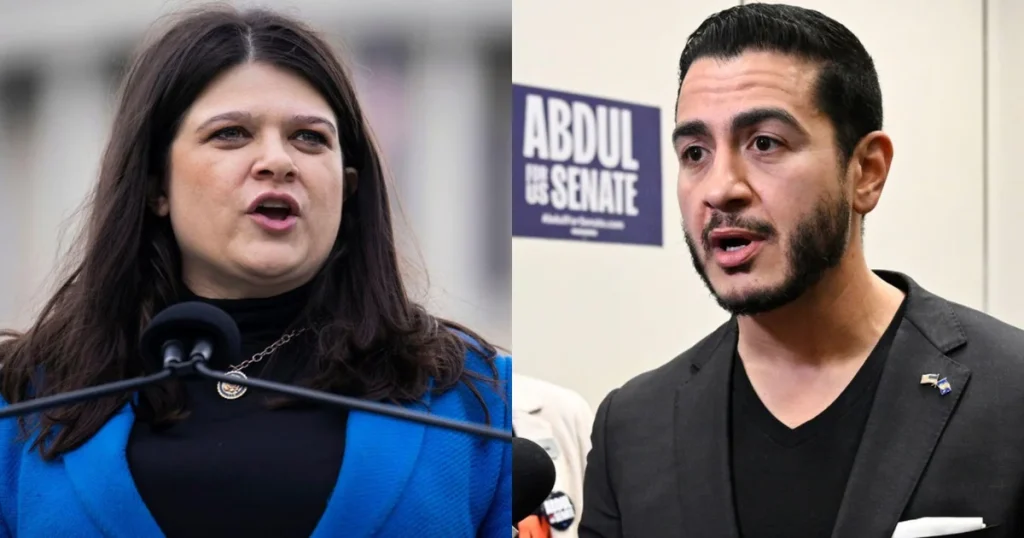
Democrats Stevens and El Sayed Clash in Michigan Senate Primary Debate
Key Issues: Israel Policy and Campaign Funding
Wertynews.com – In a pivotal Democratic Senate primary debate, Rep. Haley Stevens and former state health director Abdul El-Sayed took center stage, engaging in a spirited exchange over U.S. foreign policy and the role of political donations. The race, set to determine the Democratic candidate for Michigan’s Senate seat, intensified after state Sen. Mallory McMorrow withdrew her bid just days prior, deepening internal party divisions. With the spotlight on Stevens and El-Sayed, the debate highlighted the stark ideological contrasts that define the contest.
The primary has become a battleground for progressive and moderate voices within the Democratic Party. El-Sayed, backed by figures like Sen. Bernie Sanders and Rep. Alexandria Ocasio-Cortez, positioned himself as a reformer, while Stevens, aligned with Senate Minority Leader Chuck Schumer, championed a pragmatic approach. The discussion centered on Israel, with El-Sayed accusing Stevens of relying on Republican support to challenge former GOP Rep. Mike Rogers in November. Stevens, in turn, criticized El-Sayed for appearing too eager to secure media favor, suggesting his strategy lacked focus on tangible policy solutions.
Campaign finance emerged as a central theme, with both candidates scrutinizing each other’s financial ties. El-Sayed linked Stevens’ policies to corporate influence, pointing to her connection with the pro-Israel political action committee AIPAC. Stevens responded by highlighting El-Sayed’s financial disclosures, questioning his transparency after noting a super PAC backing him was partially funded by her opponent’s father-in-law. The exchange underscored the deepening mistrust between the two Democrats over the role of money in shaping their platforms.
A Divided Democratic Front
El-Sayed and Stevens’ debate revealed a fractured Democratic front, particularly on Israel. El-Sayed argued that the U.S. should suspend military aid to Israel, citing its alleged human rights abuses and apartheid practices. He emphasized the moral imperative of ceasing support for a government he claims is perpetuating genocide. Stevens, however, defended Israel’s right to coexist with Palestine, advocating for a two-state solution and framing the conflict as a geopolitical necessity rather than a moral failing.
Stevens also highlighted her record as a pragmatic House member, contrasting her with El-Sayed’s more radical approach. She pointed to her backing of the USMCA trade agreement, a policy El-Sayed dismissed as favoring corporations over working-class Michiganders. The candidates’ critiques of each other’s policies reflected broader tensions within the party, with voters caught between a centrist candidate and a progressive challenger. The debate’s tone grew increasingly combative, with both accusing the other of prioritizing image over integrity.
Stevens claimed El-Sayed’s campaign was a “battle of lies,” accusing him of exaggerating his alignment with progressive causes. El-Sayed, meanwhile, framed Stevens as a politician “pursuing her own agenda” through financial influence. The sharp exchanges not only underscored their differing visions for Michigan but also signaled the stakes of the race for national Democrats. As the debate unfolded, the candidates’ words painted a vivid picture of a Democratic Party split over values, strategy, and the future of Senate control.
Implications for the General Election
The August 4 primary is a critical test for Democrats seeking to reclaim the Senate. The winner will face former Rep. Mike Rogers in November, a race that could determine the party’s ability to secure control of the chamber. With four additional seats needed to offset losses, the outcome of this contest carries significant weight for the national agenda. Stevens and El-Sayed’s clash has already captured attention, with their positions on Israel and campaign money becoming key differentiators in the race.
El-Sayed emphasized that the primary is more than a state-level contest—it’s a referendum on the Democratic Party’s direction. He argued that Stevens’ ties to corporate donors make her unfit to represent Michigan’s working families, while Stevens contended that El-Sayed’s reliance on progressive allies, such as Sanders and Ocasio-Cortez, could alienate moderate voters. The debate’s intensity suggests that the candidates are aware of the broader implications, as their strategies will shape the national narrative in the coming months.
As the discussion concluded, moderator Rick Albin allowed candidates 30 seconds to address the “whatever this is that’s going on here,” prompting a direct confrontation. Stevens accused El-Sayed of framing the race as a contest of “truth and deception,” while El-Sayed retorted that she was “buying votes with her own agenda.” The showdown has left voters divided, with the general election poised to be a high-stakes battle over ideology, ethics, and the future of the Democratic Party in Michigan.