
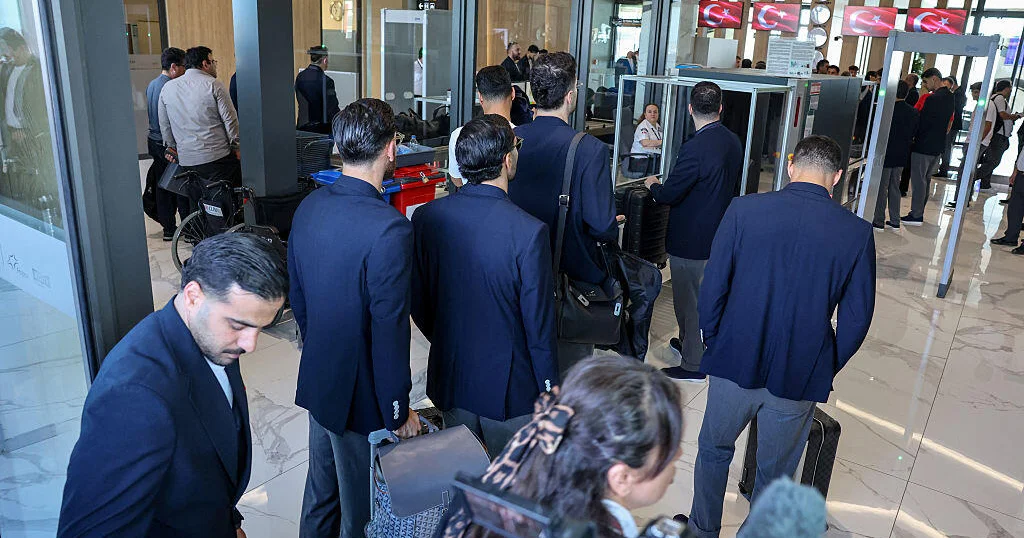
Iran Soccer Team Departs for Mexico World Cup Amid Visa Disputes
Wertynews.com – The Iran soccer team departs for Mexico ahead of the 2026 World Cup, marking a significant shift in their pre-tournament strategy. After facing visa challenges in the United States, the Iranian squad left Turkey on Saturday, heading to their training base in Tijuana, Mexico, to prepare for crucial matches. The team’s departure underscores the diplomatic tensions that have affected their participation in the tournament, with some key officials unable to secure visas for the upcoming games.
Visa Issues and Strategic Relocation
Iranian state media confirmed that 14 team officials, including senior figures like federation secretary-general Hedayat Mombeini and vice president Mehdi Mohammad Nabi, were denied U.S. entry. The visa rejections have forced the team to relocate their training facilities from Tucson, Arizona, to Mexico, where they will continue preparations without interruption. The federation’s president, Mehdi Taj, is still awaiting his own visa, though his absence does not hinder the team’s readiness.
“The Iranian national team has been denied a level playing field in the U.S., which has disrupted their preparation for the World Cup,” said an official statement from the Iranian Football Federation.
The team’s decision to move to Mexico reflects the growing impact of political considerations on international sports. While the U.S. has processed visas for the squad, it has been accused of prioritizing diplomatic disputes over athletic competition. This has raised concerns about the fairness of the tournament, with Iran’s participation now contingent on the visa situation being resolved.
Political Tensions and FIFA’s Role
The Iranian Football Federation has taken a firm stance, criticizing the U.S. for its “vindictive behavior” in rejecting visas for key personnel. They argue that the denial of entry constitutes political interference, undermining the spirit of global sportsmanship. Despite these allegations, FIFA President Gianni Infantino has reaffirmed Iran’s place in the World Cup, emphasizing that the tournament will proceed as planned.
“We are confident that Iran will compete in the World Cup without any hindrance, and the U.S. will fulfill its obligations as a host nation,” Infantino stated during the FIFA Congress in Vancouver.
The Iranian Embassy in Ankara also highlighted the issue, noting that U.S. Ambassador Tom Barrack had praised the visa process for the team. This has led to accusations of inconsistency, with the federation claiming that the U.S. is using the World Cup as a platform for political influence. The dispute has sparked debates about the role of diplomacy in sports events and the potential for such conflicts to affect team performance.
Team Composition and Competitive Strategy
The Iran soccer team departs for Mexico in a squad that includes 17 home-based players, some of whom have been affected by the country’s ongoing conflict. These players, whose clubs suspended activities since February, are now fully committed to representing Iran in the tournament. Despite the challenges, the team has maintained its focus on preparation, with players and coaches working closely to adapt to the new location.
“This relocation is not a setback but an opportunity to strengthen our team’s cohesion and readiness,” said a player from the squad in a recent interview.
Key players, including star forward Sardar Azmoun, have been integral to the team’s strategy. Azmoun, who was initially excluded in March due to a social media post, has since returned to the fold. The team’s uniform, a blue blazer over a white T-shirt, symbolizes their determination to compete on an equal footing despite the visa obstacles. They are expected to arrive in Mexico shortly, with a rigorous schedule of training sessions and tactical adjustments ahead of their first matches.
Match Schedule and Tournament Impact
The Iranian team’s World Cup campaign begins with three group games, set to take place in the U.S. starting June 15. Their matches against New Zealand, Belgium, and Egypt will be critical for securing a spot in the knockout stages. A potential showdown with the U.S. in the round of 32 on July 3 could be a defining moment, depending on the outcomes of earlier fixtures.
“The Iran soccer team departs for Mexico with the goal of making a strong impression on the global stage, despite the challenges we’ve faced,” noted a spokesperson for the Iranian Football Federation.
The relocation to Mexico has also provided the team with a chance to acclimate to the climate and altitude, which could be advantageous for their physical conditioning. While the U.S. has been a traditional host for the team, the change in location highlights the growing complexity of international sports events in an era of geopolitical tensions. The Iranian squad remains optimistic about their prospects, with fans and officials alike rallying behind their efforts to compete at the highest level.
Broader Implications for International Football
The visa dispute involving the Iran soccer team departs for Mexico has drawn attention to the broader implications for international football. It raises questions about how diplomatic relations influence athletic competition and whether such barriers could set a precedent for future tournaments. FIFA has been urged to mediate the situation, ensuring that all teams have equal access to host countries and that political considerations do not overshadow sporting integrity.
“Sports should unite nations, not divide them. We are committed to resolving this issue and ensuring the Iran soccer team departs for Mexico is treated fairly,” said a FIFA official in a recent press briefing.
As the World Cup approaches, the Iranian team’s journey to Mexico serves as a reminder of the challenges athletes face in navigating both sporting and political landscapes. Their ability to adapt and perform under these circumstances will be a testament to their resilience and the support they receive from their country. The upcoming matches will be closely watched, not only for their sporting significance but also as a symbol of the team’s determination to overcome adversity and represent Iran on the global stage.